How does the Sauna impact heart health? | SaunaBox
Heart Health & Summer Heat

How does the Sauna impact heart health?

Here's what the study found, and why frequency may be the detail that matters most.

By SaunaBox  ·  8 min read

Athlete training next to SaunaBox in summer

Summary

Summer heat already stresses the cardiovascular system. This article covers what happens to your heart rate, blood vessels, and cardiac output inside a sauna session, why Finnish population data links regular sauna use to lower cardiovascular mortality, and how the controlled heat exposure from a SaunaBox creates a repeatable cardiovascular training stimulus you can use year-round.

Most people know that exercise is good for the heart. Fewer people know that controlled heat exposure creates a similar cardiovascular response, without the mechanical load on joints, muscles, or connective tissue.

When you sit in a sauna, your heart rate rises, your blood vessels widen, and your cardiac output increases to move blood toward the skin for cooling. The body treats it as a cardiovascular event. The question researchers have been asking is whether repeating that event regularly produces lasting cardiovascular benefit.

The data from Finland, where sauna use is a cultural institution, suggests it does. And in summer, when ambient heat is already stressing the cardiovascular system, understanding that relationship matters more than ever.

What happens to the cardiovascular system during a session

The sequence is consistent and measurable. As core temperature rises, the body initiates a cascade of vascular and cardiac responses designed to move heat from the core to the skin surface for dissipation.

The cardiovascular cascade

Heat Exposure

Ambient temperature rises. The body begins detecting thermal stress.

Core Temperature Rises

Internal temperature climbs. The hypothalamus triggers cooling responses.

Blood Vessels Widen

Peripheral vasodilation increases blood flow toward the skin surface.

Heart Rate Increases

Heart rate rises to 100–150 bpm — comparable to moderate aerobic exercise.

Cardiac Output Rises

Volume of blood pumped per minute can increase by 60–70%. The cardiovascular system is working.

Estimated heart rate during a 20-minute session
60 bpm 90 bpm 120 bpm 150 bpm Entry 10 min Exit

Heart rate during a typical session rises to between 100 and 150 beats per minute, comparable to a moderate-intensity aerobic workout. Cardiac output can increase by 60 to 70 percent. The peripheral vascular resistance drops as vessels dilate, and systolic blood pressure typically falls during the session before returning to baseline during cool-down.

This is not a side effect. It is the mechanism. The cardiovascular system is being asked to do real work, and it responds accordingly.

In summer, the cardiovascular system is already working harder

Athlete stepping out of SaunaBox outdoors in summer

The body manages both training load and ambient heat simultaneously in summer.

When ambient temperatures are high, the cardiovascular system is already managing a thermal load before training begins. Blood is being rerouted toward the skin. Sweat rate is elevated. The heart is working to maintain core temperature even at rest.

Add a training session on top of that, and the cardiovascular demand compounds. The body has to manage exercise-induced heat production and ambient heat simultaneously, which is why perceived exertion is higher in summer at the same pace or load.

The body treats heat as a cardiovascular event. Repeating that event in a controlled environment may be one of the most efficient ways to train the system without adding mechanical load.

SaunaBox Research Summary

What regular sauna use appears to do is improve the efficiency of that response. The vascular system becomes more responsive. The heart learns to manage increased output with less strain. The cool-down phase becomes more efficient. These adaptations are the same ones that make heat-acclimatized athletes perform better in warm conditions.

Heat challenges the blood vessels to respond

When body temperature rises, the vascular system responds by dilating peripheral blood vessels to increase blood flow toward the skin. This is vasodilation, and it is the primary mechanism by which the body dissipates heat.

Blood flow to skin surface — relative to resting baseline
Resting (22°C)
Warm (38°C)
Sauna (60–80°C)

Illustrative. Based on published ranges from thermoregulation research.

The heart then pumps more blood per minute to support that demand. This creates cardiovascular demand without adding mechanical stress to the musculoskeletal system, which is why sauna is sometimes described as passive cardiovascular conditioning.

Man inside SaunaBox infrared sauna session

What happens after the session

Sauna studies have observed wider blood vessels, reduced resistance to blood flow, and changes in vascular stiffness after sauna use. The value comes from a controlled vascular challenge followed by recovery.

The session cycle
Heat
Stress
Increased
Circulation
Vascular
Response
Cool-down

The pattern is what makes regular sauna use interesting from a cardiovascular standpoint. Each session is a controlled vascular challenge followed by a recovery period. That pattern, repeated consistently, is what the Finnish population data reflects.

Frequency may matter

SaunaBox session data overview

Long-term Finnish studies have linked more frequent sauna use to lower rates of cardiovascular death and all-cause mortality. These studies show an association, not proof that sauna caused the outcome.

2–3×
per week — baseline in most studies
4–7×
per week — strongest association in data
20 min
typical session length studied

But the findings match what happens during each session. Heat stress. Increased circulation. Vascular response. Cool-down. That full cycle is why sauna continues to appear in cardiovascular research.

Repeated sessions turn the equation into a routine

  • 1

    The heart rate rises

    Comparable to moderate aerobic exercise. The cardiovascular system is doing real work.

  • 2

    Blood vessels dilate

    Peripheral vasodilation increases blood flow to the skin. Cardiac output rises to meet the demand.

  • 3

    The body cools down

    The cool-down phase is part of the stimulus. The vascular system returns to baseline, completing the cycle.

  • 4

    Repeated sessions accumulate

    The population data suggests the cardiovascular benefit is dose-dependent. Frequency is the variable that matters most.

Sources: Laukkanen et al., JAMA Internal Medicine, 2015 · Laukkanen et al., Mayo Clinic Proceedings, 2018

The findings match what happens during each session

Heat stress. Increased circulation. Vascular response. Cool-down. SaunaBox makes the routine easier to repeat at home, without relying on a gym or shared sauna.

Explore SaunaBox

The strongest population data points to regular use

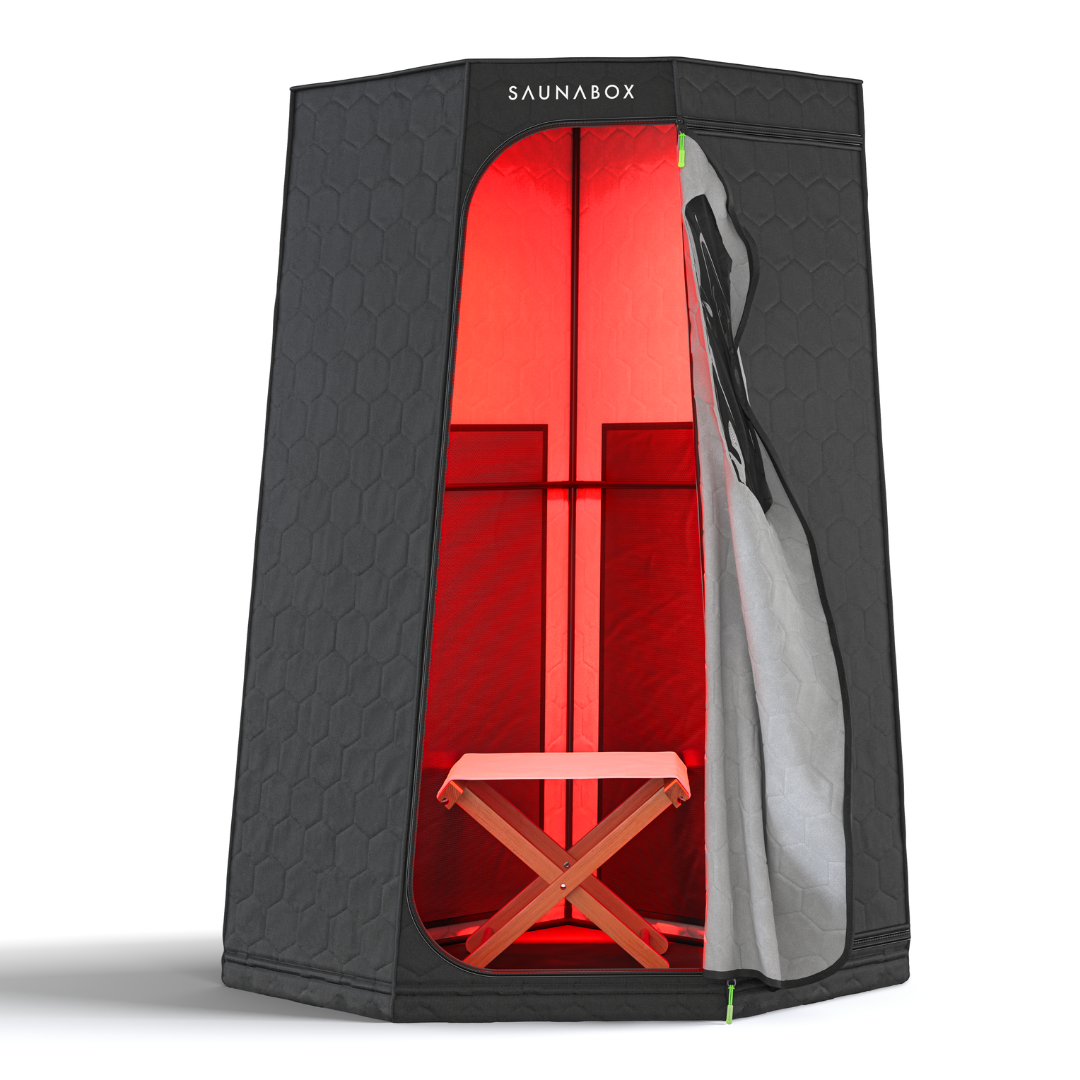
SaunaBox infrared sauna unit with red light active

The Finnish studies followed over 2,000 middle-aged men for more than 20 years. Participants who used a sauna 4 to 7 times per week had significantly lower rates of fatal cardiovascular events compared to those who used it once a week.

The researchers controlled for physical activity, smoking, alcohol use, and other cardiovascular risk factors. The association held. Sauna frequency was independently associated with cardiovascular outcomes.

Regular use appears to repeatedly improve the cardiovascular system

Increased cardiac output

Heart pumps more blood per minute during each session

Vascular dilation

Blood vessels widen and become more responsive over time

Reduced vascular stiffness

Arteries become more elastic with consistent heat exposure

Autonomic regulation

Nervous system becomes better at managing cardiovascular transitions

That last point gives the population data a plausible mechanism. It is not just that people who use saunas more often are healthier for other reasons. The cardiovascular system is being trained each time, and the training accumulates.

SaunaBox makes the routine easier to repeat

SaunaBox gives you controlled heat exposure at home, without relying on a gym or shared sauna. The routine is simple. The consistency is what compounds.

Consistent access

No scheduling, no commute. Your session is available every day, which is the only way to hit 4–7 sessions per week.

Controlled temperature

Medical-grade infrared heat up to 160°F. Precise enough to create a real cardiovascular stimulus, session after session.

Full-spectrum infrared

Near, mid, and far infrared wavelengths penetrate deeper than traditional saunas, creating a more efficient thermal response.

Red and NIR light included

Pulse Pro combines infrared heat with 660nm and 850nm light panels. Two recovery mechanisms in one session.

The SaunaBox lineup

Best for Recovery
SaunaBox Pulse PRO
4.9
Pulse PRO
Next evolution in portable infrared saunas. 320 total LEDs — 660nm red light and 850nm near-infrared. Infrared heat up to 160°F.
View Pulse PRO
SaunaBox Solara
4.9
Solara
Full-spectrum infrared wooden sauna. Medical-grade heat up to 160°F. Traditional Finnish sauna experience at home.
View Solara
New
SaunaBox Forge
4.8
Forge
Our traditional Finnish dry sauna. Authentic heat experience with modern engineering and premium cedar construction.
View Forge

Got Questions?

Text a product specialist.

Real answers in under an hour — no bots, no scripts.

Text Us Now  →