


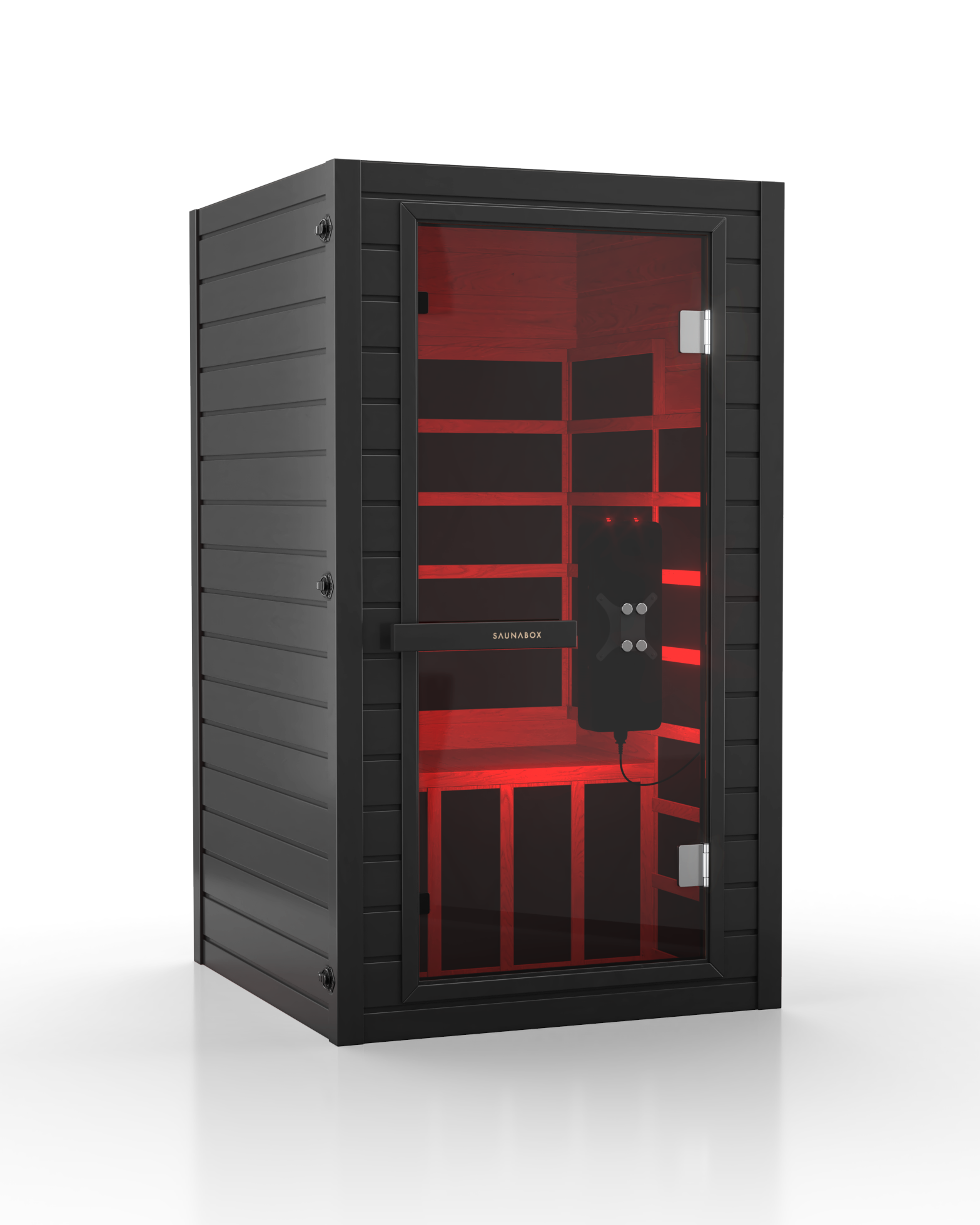
The SaunaBox Solara and the Sun Home Solstice™ 1-Person are both single-person indoor infrared cabins sold in the US right now. The Solstice 1 is the cheapest sauna Sun Home makes. It is $4,999. The Solara is $2,799. That is a $2,200 gap for two boxes that go in the same corner of the same spare room. Here is every published number from both brands, with the source named for each one.

How do the SaunaBox Solara and Sun Home Solstice 1 compare on published specs?
Direct answer
The Sun Home Solstice 1 costs $4,999 and the SaunaBox Solara costs $2,799. That is a $2,200 gap. The Solstice is a heavier eucalyptus cabin with a 7-year cabinetry and heater warranty, and it needs a dedicated 20-amp circuit. The Solara adds near and mid infrared plus a 660nm and 850nm red light panel, runs on a standard outlet, and publishes an Intertek IEC 62233 EMF certificate. Sun Home states in their own words that the Solstice is far infrared only with no red light therapy.
| Specification | Sun Home Solstice™ 1 | SaunaBox Solara | Source / Basis |
|---|---|---|---|
| Price | $4,999 (list $5,599) | $2,799 (reduced from $3,000) | sunhomesaunas.com/products/sun-home-solstice-1-person-infrared-sauna. saunabox.com/products/solara-full-spectrum-infrared-sauna. Both checked Aug 16, 2026. |
| Infrared type | Far infrared only. Sun Home: "the Solstice's far-infrared only." | Full spectrum. "Near, Mid & Far Infrared (NIR, MIR, FIR)." | sunhomesaunas.com/blogs/saunas/sun-home-sauna-comparison. saunabox.com Solara specifications block. |
| Red light therapy | Not included. Sun Home: "Equinox and Solstice do not include RLT." | Medical-grade 660nm + 850nm LEDs, V2 swivel panel, built in. | sunhomesaunas.com/collections/best-infrared-saunas. saunabox.com Solara specifications block. |
| Max temperature | 165°F, published in Sun Home's model comparison. Not published on the Solstice product page itself. | 150°F. Range published as 77° to 150°F. | sunhomesaunas.com/blogs/saunas/sun-home-sauna-comparison. saunabox.com Solara specifications block. |
| Heat-up time | Not published. Sun Home: "heat up time is dependent on ambient temperature." | Not published on the product page. | sunhomesaunas.com Solstice 1 spec sheet. saunabox.com, checked Aug 16, 2026. |
| Heaters | "Heaters: 8 FIR." Count published. | "Ultra-Low EMF Infrared Panels." Panel count not published. | sunhomesaunas.com Solstice 1 spec sheet. saunabox.com Solara specifications block. |
| Wattage | 1,350W | 1,600W (50/60Hz) | Product pages of both brands. |
| Electrical requirement | "Plugs into a 120v / 20 amp dedicated circuit and outlet." Plug: NEMA 5-20R, 5-20P. | 110V standard household outlet. No electrician required. 8 ft cord. | sunhomesaunas.com Solstice 1 spec sheet. saunabox.com Solara product page. |
| EMF | "0.5 mG" published. Sun Home's own articles attribute it to Vitatech Electromagnetics at "a typical 3-foot seated position." No IEC standard named. | "Low-EMF Verified by Intertek® IEC 62233 Certified," with a test report linked on the product page. | sunhomesaunas.com Solstice 1 page and sun-home-vs-other-home-sauna-brands. saunabox.com Solara certifications block. |
| Wood / interior material | "Eco-certified Kiln-dried Eucalyptus." | "100% Canadian Hemlock." Sustainably sourced. | Product pages of both brands. |
| Exterior dimensions | 37.8″ W × 39.8″ D × 77.7″ H (includes 2″ feet). Door opening 28″. | 35″ W × 37″ D × 63″ H. | Product pages of both brands. |
| Interior dimensions | 32.2″ W × 33.6″ D × 70.3″ H. Bench 32.1″ × 20.2″ at 19.5″ high. | Not published on saunabox.com as of Aug 2026. | sunhomesaunas.com Solstice 1 spec sheet. saunabox.com, checked Aug 16, 2026. |
| Clearance required | "leaving 4-6 inches around the sauna and 8-10 inches above the roof." | Not published on saunabox.com as of Aug 2026. | sunhomesaunas.com Solstice 1 spec sheet. saunabox.com, checked Aug 16, 2026. |
| Assembled weight | 428 lbs | 172 lbs. Supports up to 300 lbs. | Product pages of both brands. |
| Assembly method | "Magne-Seal system," and it "requires no power tools and zero screws or nails." No time published. | Four pre-assembled panels with pre-installed locking clips. Under 30 minutes. No tools. | Product pages of both brands. |
| Controls | Digital panel, programmable 24-hour timer, reservation mode. Sun Home lists "no app" for the Solstice. | On-unit controls. 0 to 90 minute timer. Adjustable 77° to 150°F. | sunhomesaunas.com Solstice 1 page and sun-home-sauna-comparison. saunabox.com Solara specifications block. |
| Chromotherapy | "Medical-grade chromotherapy lighting." Color count not published. | Built-in chromotherapy, 10 colors. | Product pages of both brands. |
| Audio | "Premium bluetooth surround sound system." Blaupunkt speakers. | Bluetooth audio system. | Product pages of both brands. |
| Third-party testing named | Vitatech Electromagnetics for EMF. VERT / LA Testing under EPA Method TO-15 for VOC. | Intertek. IEC 62233 EMF certificate and a Prop 65 report on 20 components, both linked as PDFs on the product page. | sunhomesaunas.com/collections/best-infrared-saunas. saunabox.com Solara certifications block. |
| Warranty | "limited lifetime warranty (7 years) on cabinetry and heaters, and 3 years on controls." | SaunaBox publishes warranty terms on the Solara product page. Confirm the current terms in writing before you buy. | sunhomesaunas.com Solstice 1 warranty section. saunabox.com, checked Aug 16, 2026. |
| HSA / FSA | Not mentioned on the Solstice product page. | TrueMed® partner. May be eligible for HSA or FSA funds for qualified buyers. | Product pages of both brands. |
| Shipping | "Free Shipping Included." | Free shipping, delivers in 7 to 12 days. Curbside freight, two boxes, around 220 lbs total. | Product pages of both brands. |
| Published running cost | Not published. | "A 30-minute session consumes approximately 0.8 kWh, costing roughly $0.14" at the US average rate of ~17.65¢/kWh. | saunabox.com Solara FAQ. sunhomesaunas.com, checked Aug 16, 2026. |
What is the real difference between the Solara and the Solstice 1?
Direct answer
The real difference is what the extra $2,200 buys. On the Solstice you get more cabin. That means 428 lbs of eucalyptus, a taller box, a published interior spec and a 7-year warranty. You do not get more light. The Solstice is far infrared only with no red light therapy. The Solara spends its money on the emitters instead, in a 172 lb cabin that plugs into a normal outlet.
This is not a good sauna against a bad sauna. It is a furniture-first sauna against an emitter-first sauna.
Sun Home is open about the trade. They call the Solstice the "Lowest-priced premium-build Sun Home." What they cut to hit that entry point is the heat technology. Full-spectrum heaters live on the Equinox, Eclipse and Luminar. Red light lives on the Eclipse and the Pod. The Solstice gets neither.
SaunaBox made the opposite trade. The Solara is smaller, lighter and built in hemlock. What it carries is the full wavelength set plus a dedicated red light panel, in one cabin, at $2,799.
So the question is not "which one is better." It is "am I paying for the box or for what is inside it."
Is the Sun Home Solstice 1 a full-spectrum infrared sauna?
Direct answer
No. It is far infrared only. Sun Home says so on their own site: "Equinox is the stronger sauna on specs: it delivers full-spectrum infrared (near + mid + far) vs. the Solstice's far-infrared only." The Solstice product page lists "Heaters: 8 FIR." Full-spectrum heaters sit on Sun Home's Equinox, Eclipse and Luminar lines instead.
This matters because "infrared sauna" and "full-spectrum infrared sauna" get used as if they mean the same thing. They don't. Plenty of cabins between $4,000 and $6,000 are far infrared only. The word "premium" describes the cabinetry budget, not the wavelengths.
Sun Home deserves credit here. They state it plainly instead of burying it. Their collection page repeats it: "Equinox and Solstice do not include RLT." Most brands would never write that about their own product.
Infrared is one slice of the electromagnetic spectrum. The sauna industry splits it into three bands.
Far infrared (FIR) sits at the long end. It is what carbon heater panels emit naturally, which is why nearly every infrared cabin has it. It is absorbed close to the surface and drives the sweat response people associate with a session.
Mid infrared (MIR) sits between the two. It is associated in the literature with soft tissue and circulation.
Near infrared (NIR) sits at the short end, closest to visible red. It behaves differently from the other two. Near infrared is the band studied in photobiomodulation research. That research asks what light does to cells, not what heat does to skin.
"Full spectrum" means the cabin emits all three. That is a manufacturing decision, not a marketing one. It needs heater types beyond a standard carbon panel, and it shows up in the bill of materials.
The Solara's specification block reads "Full-Spectrum Infrared: Near, Mid & Far Infrared (NIR, MIR, FIR)." The Solstice 1's reads "Heaters: 8 FIR." Two different products, same category name.
None of this makes far infrared bad. It is the most common form of infrared heat. It means only this. If wavelength coverage is why you are buying, the Solstice 1 is not the Sun Home model that delivers it. The Equinox is, at $6,099 and up.
Does either sauna include red light therapy?
Direct answer
Only the Solara. It has a built-in medical-grade red light panel at 660nm and 850nm on a V2 swivel mount, so the light can be aimed at one area. Sun Home states the Solstice does not include red light therapy. In their range, red light is standard on the Eclipse and the Pod, and an add-on on the Luminar.
Watch the word "chromotherapy" here. It is where most buyers get confused. Both cabins have it. Sun Home calls theirs "Medical-Grade Chromotherapy" and the Solara has a 10-color system. Chromotherapy is colored ambient LED lighting. It sets the mood inside the cabin.
Red light therapy is something else. It is a specific pair of wavelengths at a delivered intensity. 660nm sits in the visible red band, 850nm in the near infrared band. Those two are the most studied in photobiomodulation research. A colored LED strip that can turn red is not a 660nm therapy panel.
If red light is part of why you are buying, the fair comparison shifts. It is the Solara at $2,799 against a Sun Home Eclipse 2 at $9,999 or a Sun Home Pod at $6,599. Those are the models in their range with an integrated red light system.
How does EMF compare between the Solara and the Solstice 1?
Direct answer
The two brands answer the EMF question in two different ways. The difference is the method, not the number. Sun Home publishes a figure: "0.5 mG." SaunaBox publishes a certification: "Low-EMF Verified by Intertek® IEC 62233 Certified," with the test report linked on the product page. A bare milligauss reading and a standards-based certificate are not the same kind of evidence. You cannot subtract one from the other.
A magnetic field falls off fast with distance. Move a probe a few inches and the reading changes a lot. So a milligauss figure only means something with three things attached. Where the probe was, what the appliance was doing, and which method was followed.
That is what IEC 62233 exists to fix. Its title is "Measurement methods for electromagnetic fields of household appliances and similar apparatus with regard to human exposure." It defines the sensor, the measuring method, the operating mode of the appliance under test, and the measuring distance and position. Its methods are valid from 10 Hz to 400 kHz. In short, the standard removes the choices that let two labs get two very different numbers from the same machine.
The Solara is certified to that standard by Intertek, and the certificate downloads from the product page. That is a method claim, not a number claim. It is the stronger of the two forms.
Sun Home's Solstice page states this: "Patented EMF/ELF shielding technology ensures the lowest electromagnetic field exposure in the industry (0.5 mG - lower than most household appliances!)." Elsewhere on their own site they name the lab and the position. Vitatech Electromagnetics, at "0.3-0.9 mG at a typical 3-foot seated position." That detail is genuinely useful and more than most brands publish. Sun Home also writes that "measurement conditions differ between brands." They are right.
Here is the practical takeaway. A 3-foot seated reading describes the field where a torso sits. It says nothing about the field an inch from the heater panel. In a one-person cabin, that panel is where your back rests. Neither brand publishes a panel-surface figure.
So if EMF is why you are shopping, ask both companies for the measurement distance in writing. Or ask which standard the test followed. What you should not do is put "0.5 mG" next to "IEC 62233 certified" and decide one is smaller. They answer different questions.
How hot does each sauna get, and how fast does each heat up?
Direct answer
The Solstice 1 is the hotter cabin on paper at 165°F. Sun Home publishes that figure in their model comparison article, not on the Solstice product page. The Solara publishes an adjustable range of 77° to 150°F. Neither brand publishes a heat-up time. Sun Home says "heat up time is dependent on ambient temperature." SaunaBox states no figure either.
Worth knowing that infrared cabins are not judged the way traditional saunas are. Infrared warms the body directly rather than heating the air, so air temperature is only one input into how a session feels. That is also why a traditional Finnish sauna runs at 190°F and up. Different mechanism, different number. If a 200°F dry heat room is what you want, infrared is the wrong category. A stove sauna like the SaunaBox Forge is the right one, and it is excellent at exactly that.
On heat-up time, neither brand will give you a number. So the only fair move is to look at the inputs. This calculation is ours. Neither company publishes it.
The math is simple. The Solara is 1,600W in a 35″ × 37″ × 63″ box. That is 47.2 cubic feet, so 33.9 watts per cubic foot. The Solstice 1 is 1,350W in a 37.8″ × 39.8″ × 77.7″ box. That is 67.6 cubic feet, so 20.0 watts per cubic foot. The Solara puts about 70% more power into every cubic foot.
One caveat, and it matters. Both figures use exterior dimensions, because exterior is all both brands publish. Sun Home also publishes an interior volume of 44.0 cubic feet, which is 30.7 watts per cubic foot against its own interior. SaunaBox does not publish an interior dimension, so the same math cannot be run for the Solara. Exterior against exterior is the only like-for-like available. Treat it as a directional signal, not a stopwatch.
Do you need an electrician to install either sauna?
Direct answer
The Solara plugs into a standard 110V household outlet with an 8-foot cord. No electrician. The Solstice 1 does not. Sun Home's spec sheet says it "Plugs into a 120v / 20 amp dedicated circuit and outlet" with a NEMA 5-20 plug. A dedicated 20-amp circuit is not what sits behind most bedroom walls. For many buyers that is an electrician visit on top of the $4,999.
This is the line item most comparison charts skip. It is also the one that surprises people after the pallet lands.
A NEMA 5-20 receptacle has a T-shaped neutral slot. It is a physically different outlet from the 5-15 in a typical bedroom, and it has to be on its own circuit. In a finished house that means new cable from the panel, a new breaker and a new receptacle. It is not a huge job. It is not zero either, and you cannot do it the afternoon the sauna arrives.
The Solara sidesteps that. 1,600W at 110V draws roughly 14.5 amps, inside a standard 15-amp circuit. SaunaBox states that no electrician is required. For a renter this row is close to decisive. You cannot install a dedicated circuit in an apartment you do not own.
How much room does each sauna really take up?
Direct answer
The Solara takes 9.0 square feet of floor and stands 63 inches tall. The Solstice 1 takes 10.4 square feet and stands 77.7 inches tall. Sun Home also asks for clearance on top of that: "leaving 4-6 inches around the sauna and 8-10 inches above the roof." With that clearance, the Solstice needs roughly 16.5 square feet and about 86 inches of ceiling.
Read that clearance line twice if your ceiling is low or sloped. A standard 8-foot ceiling clears it. A basement with ducting does not automatically. SaunaBox publishes no clearance requirement for the Solara, which is a gap on our page rather than a claim of zero. Ask before you plan a tight alcove.
The other number that decides where a sauna lives is weight. The Solstice 1 is 428 lbs assembled. The Solara is 172 lbs and holds up to 300 lbs of occupant. If it has to go upstairs, 256 lbs is a large difference. One person will not reposition the Solstice. The Solara comes back apart into four panels.
How do the wood and build materials compare?
Direct answer
Sun Home builds the Solstice 1 from "Eco-certified Kiln-dried Eucalyptus." They call it "the most durable hardwood" and say it "responds extremely well to heat." SaunaBox builds the Solara from "100% Canadian Hemlock," described as low in resin, resistant to warping and hypoallergenic. Both are legitimate sauna woods. Eucalyptus is the denser and pricier choice, and it is part of why the Solstice costs more.
Sun Home wins this row and it would be dishonest to dress it up. Kiln-dried eucalyptus is a hardwood. It is heavier and more dimensionally stable under repeated heat cycling. Sun Home also publishes a 7% moisture content figure, which is more detail than most brands give about wood at all.
Canadian hemlock is the more common cabin wood here, for good reasons. It is low in resin, and resin is what produces odor and sap bleed when wood is heated over and over. It is also light, which is why the Solara weighs 172 lbs.
Where it shifts is what has been tested. SaunaBox publishes an Intertek report covering 20 individual components. Plastics, metals, wiring and structural materials, screened for lead, cadmium and phthalates against California Prop 65 limits. Sun Home publishes a VOC result instead, tested by LA Testing under EPA Method TO-15. Different tests, different questions. One asks what is in the parts. The other asks what comes off into the air. Neither brand publishes both.
How does assembly and delivery compare?
Direct answer
The Solara ships as four pre-assembled panels with pre-installed locking clips. It goes together in under 30 minutes with no tools. The Solstice uses Sun Home's "Magne-Seal system" and "requires no power tools and zero screws or nails," but Sun Home publishes no assembly time. Both arrive on a pallet by freight. The 256 lb weight difference is what decides how hard your delivery day is.
Neither is a flat-pack you fight with a hex key for a weekend. Both brands engineered the panel connection so you are not screwing a cabinet together. Sun Home's magnetic seal approach deserves credit.
SaunaBox publishes the delivery detail and it is worth reading first. The Solara arrives curbside on a pallet in two boxes totalling around 220 lbs. The driver lowers it to ground level. In-home delivery and assembly cost extra. The page lists free shipping and delivery in 7 to 12 days. Sun Home lists "Free Shipping Included." At 428 lbs assembled, plan for a second pair of hands either way.
What certifications does each brand actually publish?
Direct answer
SaunaBox publishes two Intertek documents for the Solara and links both as PDFs on the product page. One is an IEC 62233 EMF certificate. The other is a California Prop 65 report covering 20 components. Sun Home names Vitatech Electromagnetics for EMF and LA Testing for VOC. Those results sit in their editorial pages, not on the Solstice product page.
Here is the rule for reading any certification badge in this category. From any brand, including this one. A certificate has a scope, and the scope is the whole claim. It belongs to one product, tested for one thing, by one lab. It does not travel across a catalog because the logo sits in the footer.
An example from our own site, since demanding this of a competitor and not ourselves would be cheap. The SaunaBox certifications page lists OEKO-TEX, and it states the scope right there. It certifies the SaunaBox GO tent. It is not a Solara certification and it is not used as one here. The same page attributes PFAS-free testing to the Pulse sauna fabric, not to the Solara. The Solara's own certifications are the two Intertek documents named above, plus the "Certified Free of Toxic Heavy Metals & Phthalates" claim that comes out of the Prop 65 testing.
Apply the same reading to Sun Home. Their EMF and VOC testing is real and their labs are named, which is more than much of this industry does. But some figures that circulate about Sun Home come from their full-spectrum models, not the Solstice.
The practical version: ask for the document, not the badge. Then read page one, where the product name and the test scope are printed.
What warranty does each sauna come with?
Direct answer
Sun Home publishes the stronger warranty and it is not close. The Solstice 1 carries a "limited lifetime warranty (7 years) on cabinetry and heaters, and 3 years on controls." Sun Home adds that their heaters have "an estimated operational life of at least 30,000 hours." SaunaBox publishes warranty terms on the Solara product page. Get the current terms in writing before you buy.
This row goes to Sun Home. Seven years on cabinetry and heaters is a real commitment and part of what the price buys. If long coverage is what lets you sleep at night, that is a legitimate reason to spend more.
One caution that applies to every brand here. A warranty headline and a warranty document are different objects. Parts coverage is not labor coverage. Labor coverage is not freight coverage on a 428 lb cabinet. Ask three things before you hand over a card. What is covered. For how long. Who pays the freight.
What does each sauna cost per session?
Direct answer
At four sessions a week over five years, which is 1,040 sessions, the Solara works out to $2.50 a session. The Solstice 1 works out to $4.81. At three sessions a week it is $3.33 against $6.41. Electricity is a rounding error next to that. SaunaBox publishes roughly $0.14 for a 30-minute session at the US average rate. Sun Home publishes no running cost figure.
Those per-session numbers are ours, from the purchase price divided by an assumed session count. Change the assumption and both move together, so the ratio is the useful part. On any schedule you keep, the Solstice 1 costs about 1.9 times as much per session.
The electricity figure is SaunaBox's own. "A 30-minute session consumes approximately 0.8 kWh, costing roughly $0.14 at the US average residential electricity rate of ~17.65¢/kWh." SaunaBox notes rates run from about 11¢ to 43¢/kWh across US states. At four sessions a week that is around $29 a year. Not the number that decides this purchase.
One more line in the ownership math applies only on the SaunaBox side. SaunaBox is a TrueMed® partner, so the Solara may be eligible for purchase with pre-tax HSA or FSA funds for qualified buyers. Eligibility comes from having the account plus a Letter of Medical Necessity from a licensed provider, at any age. It is not automatic. The Solstice product page does not mention HSA or FSA. If you have funds sitting in an HSA, that is worth an hour of your time.
What are the Sun Home Solstice 1's genuine strengths?
Direct answer
The Solstice 1 wins on warranty, wood and cabin size. Seven years on cabinetry and heaters is the longest coverage in this comparison. Kiln-dried eucalyptus is denser than hemlock. It runs 15°F hotter, it is taller, and Sun Home publishes an interior and bench dimension that SaunaBox does not.
- 7-year warranty on cabinetry and heaters, plus 3 years on controls. The longest here by a wide margin.
- Kiln-dried eucalyptus, a denser hardwood than hemlock, with a published 7% moisture content.
- 165°F published maximum against the Solara's 150°F.
- A taller cabin at 77.7″, with published interior and bench dimensions.
- Published heater count. "Heaters: 8 FIR" is more detail than the Solara page gives.
- Named third-party labs for EMF and VOC, with a stated 3-foot seated measurement position.
- Blaupunkt Bluetooth surround sound and a 24-hour timer with reservation mode.
- Sun Home states the Solstice's limits in their own words on their own site. That is rare.
What are the SaunaBox Solara's genuine strengths?
Direct answer
The Solara wins on wavelengths, price and install. It is full spectrum with a built-in 660nm and 850nm red light panel, where the Solstice is far infrared only with no red light. It costs $2,200 less, runs on a standard outlet, weighs 172 lbs, and publishes a downloadable Intertek IEC 62233 EMF certificate.
- Full-spectrum infrared. Near, mid and far, published on the specification block.
- Medical-grade 660nm and 850nm red light built in, on a V2 swivel mount. The Solstice includes none.
- $2,799 against $4,999. Well under two-thirds the cost per session on any usage assumption.
- Standard 110V household outlet, 8-foot cord. No dedicated circuit and no landlord conversation.
- Ultra-low EMF certified to IEC 62233 by Intertek, with the report downloadable from the page.
- Intertek Prop 65 report on 20 components. Certified free of toxic heavy metals and phthalates.
- 172 lbs and four clip-together panels. Under 30 minutes, no tools, and one person can move it later.
- 9.0 square feet of floor and 63 inches tall. Fits a bedroom, an office or an apartment corner.
- May be eligible for HSA or FSA funds through TrueMed® for qualified buyers.
- Published running cost of roughly $0.14 per 30-minute session at the US average rate.
- 4.6 out of 5 from 154 published reviews on the product page as of August 2026.
- One tree planted through Veritree for every Solara sold.
Who should buy the Solara and who should buy the Solstice 1?
Direct answer
Buy the Solara if you are paying for what the heaters emit. It also wins if you rent, want a standard-outlet install, or need the sauna to stay movable. Buy the Solstice 1 if you are paying for the cabinet and the coverage. It fits a buyer whose deciding factor is the 7-year warranty, with a permanent spot and a dedicated circuit available.
- You want near, mid and far infrared rather than far infrared alone.
- You want 660nm and 850nm red light in the cabin without buying a second device.
- You rent, or you do not want to pay for a dedicated 20-amp circuit.
- The sauna has to fit a bedroom or an apartment corner under 10 square feet.
- You want to be able to move it later without a freight company.
- You want a downloadable EMF certificate and a component-level Prop 65 report.
- You have HSA or FSA funds and want to check whether they can be used.
- The $2,200 saved is better spent elsewhere in your recovery setup.
- Warranty length is your deciding factor and you want 7 years on cabinetry and heaters.
- You want a eucalyptus hardwood cabin and will pay for the material.
- You want a published interior and bench dimension before you buy.
- You want the 165°F ceiling rather than 150°F.
- You have, or can easily add, a dedicated 120V 20-amp circuit.
- The sauna is going into a permanent spot and will never be moved.
- You do not need red light therapy or full-spectrum wavelengths.
Frequently asked questions
Neither is better in every category. The Solara wins on infrared spectrum, red light therapy, price, electrical simplicity, footprint and weight. The Solstice 1 wins on warranty length, wood density, maximum temperature and published interior dimensions. If you are buying for what the heaters emit, take the Solara. If you are buying for the cabinet and the coverage, take the Solstice.
No. Sun Home states on their own site that "Equinox and Solstice do not include RLT." The Solstice has medical-grade chromotherapy lighting, which is colored ambient LED lighting, not red light therapy. In Sun Home's range, integrated red light sits on the Eclipse and the Pod, and is an add-on on the Luminar.
No. It is far infrared only. Sun Home's own model comparison says the Equinox "delivers full-spectrum infrared (near + mid + far) vs. the Solstice's far-infrared only." The Solstice product page lists "Heaters: 8 FIR." The SaunaBox Solara publishes near, mid and far infrared on its specification block.
$4,999, against a listed regular price of $5,599 on sunhomesaunas.com as of August 16, 2026. The SaunaBox Solara is $2,799, reduced from $3,000, on saunabox.com as of September 25, 2026. That is a $2,200 difference. Prices in this category move often, so check both pages before you decide.
Yes. Sun Home's spec sheet says it "Plugs into a 120v / 20 amp dedicated circuit and outlet" with a NEMA 5-20R or 5-20P plug. It also warns not to use a 240V outlet. Most bedrooms have a shared 15-amp circuit and a NEMA 5-15 receptacle, so many buyers will need an electrician. The SaunaBox Solara runs on a standard 110V household outlet with no electrician required.
165°F, according to Sun Home's own model comparison article. It states that the Equinox and Solstice "share the same 0.5 mG EMF, 99% emissivity, and 165°F max temperature." The Solstice product page itself publishes no maximum temperature. The SaunaBox Solara publishes an adjustable range of 77° to 150°F.
Neither brand publishes a heat-up time. Sun Home says "heat up time is dependent on ambient temperature," and SaunaBox publishes no figure. Comparing the inputs, the Solara delivers about 33.9 watts per cubic foot of exterior volume against the Solstice's 20.0. That figure is ours, calculated from both brands' published wattage and exterior dimensions. Treat it as directional, not as a measured result.
They publish different kinds of evidence, so they are not directly comparable. Sun Home publishes 0.5 mG, attributed elsewhere on their site to Vitatech Electromagnetics at a 3-foot seated position. SaunaBox publishes an Intertek IEC 62233 certification with a downloadable report. IEC 62233 fixes the sensor, the operating mode and the measuring distance and position, which is what makes a reading comparable at all. Sun Home themselves write that "measurement conditions differ between brands."
SaunaBox is a TrueMed® partner, so the Solara may be eligible for purchase with pre-tax HSA or FSA funds for qualified buyers. Eligibility comes from having the account plus a Letter of Medical Necessity from a licensed provider, at any age. It is not automatic. The Sun Home Solstice 1 product page does not mention HSA or FSA eligibility as of August 2026.
Then neither cabin here is the right category. Infrared warms the body directly instead of heating the air. That is why these units run at 150° to 165°F rather than the 190°F and up you get from a stove sauna. If you want water on hot stones and a properly hot room, look at a traditional Finnish sauna such as the SaunaBox Forge. The air carries the heat, it is a mechanism that has worked for thousands of years, and it is excellent at exactly that. Two different tools. Pick the one that fits the space you actually have.
The bottom line
SaunaBox Solara vs Sun Home Solstice™ 1-PersonThe Sun Home Solstice 1 is a well-built premium cabinet with the best warranty here, a denser hardwood and a higher temperature ceiling. It is also far infrared only, includes no red light therapy, weighs 428 lbs, needs a dedicated 20-amp circuit, and costs $4,999.
The SaunaBox Solara is $2,799. For $2,200 less it adds near and mid infrared, a 660nm and 850nm red light panel, an Intertek IEC 62233 EMF certificate and a component-level Prop 65 report. It installs on a standard outlet, takes 9.0 square feet, and weighs 172 lbs.
If you are paying for the cabinet and the coverage, the Solstice earns its price. If you are paying for what the heaters emit, the Solara delivers more of it for roughly half the money.
Shop the SaunaBox SolaraSources and references
- SaunaBox Solara 1-Person Full Spectrum Infrared Sauna product page, specifications block and FAQ -- saunabox.com. Checked August 16, 2026.
- SaunaBox safety certifications page -- saunabox.com. Checked August 16, 2026.
- Sun Home Solstice™ 1-Person Indoor Infrared Sauna product page and spec sheet -- sunhomesaunas.com. Source for price, dimensions, weight, heater count, wattage, electrical requirement, clearance, wood type, EMF figure, assembly method and warranty. Checked August 16, 2026.
- Sun Home Sauna Comparison (2026): Which Model Is Right for You? -- sunhomesaunas.com. Source for the Solstice being far infrared only, the 165°F maximum, and the eucalyptus moisture figure. Checked August 16, 2026.
- Sun Home infrared sauna collection page -- sunhomesaunas.com. Source for "Equinox and Solstice do not include RLT," the 7-year warranty statement, and the LA Testing VOC result. Checked August 16, 2026.
- Sun Home Saunas vs Other Brands (2026): How We Compare -- sunhomesaunas.com. Source for the Vitatech Electromagnetics attribution, the 0.3-0.9 mG at 3-foot seated figure, and the statement that measurement conditions differ between brands. Checked August 16, 2026.
- IEC 62233 Ed. 1.0:2005, "Measurement methods for electromagnetic fields of household appliances and similar apparatus with regard to human exposure" -- International Electrotechnical Commission. The standard defines the sensor, the measuring method, the operating mode of the appliance under test, and the measuring distance and position. Its methods are valid from 10 Hz to 400 kHz. Available through the IEC webstore and national standards distributors.
- SaunaBox Solara IEC 62233 EMF test report (Intertek) -- linked on the saunabox.com Solara product page.
- Laukkanen JA et al. Cardiovascular and Other Health Benefits of Sauna Bathing: A Review of the Evidence. Mayo Clinic Proceedings, 2018.
- Hamblin MR. Mechanisms and applications of the anti-inflammatory effects of photobiomodulation. AIMS Biophysics, 2017.
HAVE QUESTIONS?
Text a SaunaBox product specialist.
No bots. Real answers in under an hour.
 Text Us Now
Disclaimer: This content is for informational and comparison purposes only and should not be construed as medical advice. All specifications reflect what each brand published on their own website as of August 16, 2026. Calculated figures are labeled as such where they appear. Verify current specifications, pricing and warranty terms directly with each brand before purchasing. If you have any underlying health conditions, consult a qualified healthcare clinician before beginning sauna therapy.


