


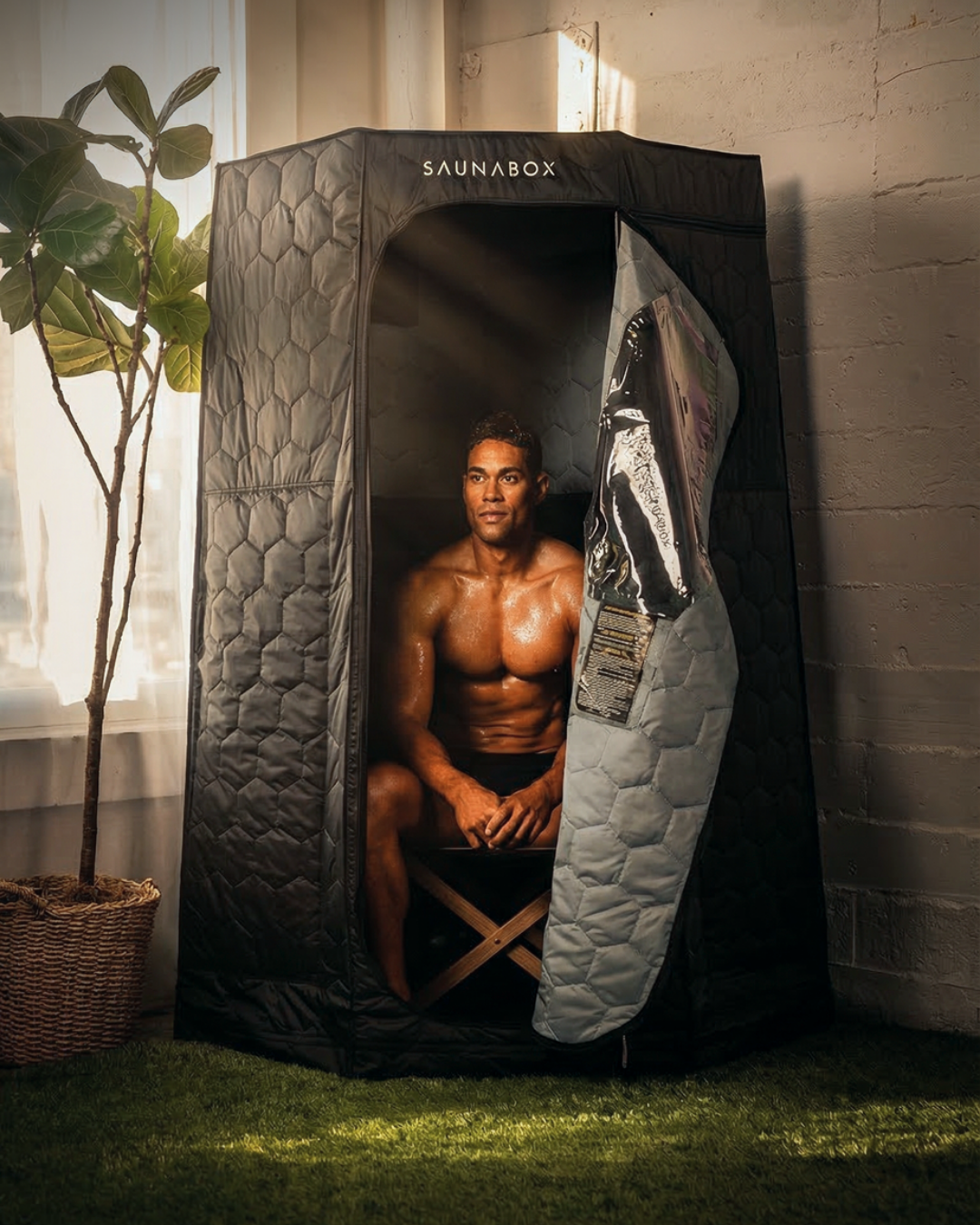
The SaunaBox Pulse PRO and the HigherDOSE Infrared Sauna Blanket are the two most compared portable infrared products in the US, and they cost exactly the same: $699. The Pulse PRO is a standing tent sauna, 36″ L x 36″ W x 68″ H. It runs 1,600W of ThermoCell far-infrared panels and 320 medical-grade red light LEDs at 660nm and 850nm, built into the tent. The HigherDOSE blanket is a lie-down bag with one heating zone, 350 to 420 watts, a 175°F top setting and no light therapy of any kind. Same money, very different device. Here is every published spec, with the source for each one.

What are the published specs for the SaunaBox Pulse PRO and the HigherDOSE Infrared Sauna Blanket?
Direct answer
Both products list at $699. The Pulse PRO publishes 1,600W of far-infrared panel power, a 36″ x 36″ x 68″ standing enclosure, 320 red light LEDs at 660nm and 850nm, and a 1-Year Limited Warranty. The HigherDOSE blanket publishes one heating zone, 350 to 420 watts, up to 175°F, a 1-hour timer and a 1-Year limited warranty, with no light therapy included. Neither brand publishes a product weight.
| Specification | HigherDOSE Infrared Sauna Blanket | SaunaBox Pulse PRO | Source / Basis |
|---|---|---|---|
| Price | $699 | $699 (list $900) | higherdose.com/products/infrared-sauna-blanket and saunabox.com product page, 16 Aug 2026. |
| Product type | Lie-down sauna blanket. You lie inside and zip it closed. | Standing tent sauna. You sit or stand inside a full enclosure. | Product pages of both brands. |
| Red light therapy | Not included. HigherDOSE sells red light as separate products. | 320 LEDs, 660nm red plus 850nm near-infrared, built into the tent. Irradiance 63.19mW/cm2 at surface. | saunabox.com feature block. higherdose.com blanket page lists no light therapy in Tech Specifications or In the Box. |
| Heating power | 350-420 Watts. 4-5 Amps. | 1,600W / 50-60Hz. ThermoCell far-infrared panels. | higherdose.com "Tech Specifications". saunabox.com "Specifications". |
| Heat zones | One heating zone. | 6x ThermoCell infrared panels. | higherdose.com "Tech Specifications". saunabox.com "What's Included". |
| Max temperature | Up to 175 degrees F. | ~160°F max internal heat (varies by environment). | Both figures quoted verbatim from the two product pages. |
| Controls | Black handheld controller, 1-9 heat levels. | Bluetooth controller and remote control system. | Product pages of both brands. |
| Timer | 1 hour maximum. | Session control via the Bluetooth controller. Maximum timer duration not published. | higherdose.com "Tech Specifications". saunabox.com checked Aug 2026. |
| Published heat-up time | Preheat 10-15 minutes, stated in the brand's own How to Use steps. | Not published on saunabox.com. | higherdose.com "How to Use", Step 1. saunabox.com checked Aug 2026. |
| EMF claim | "Electrical Field: Low EMF." No standard named, no test report published. | Ultra-low EMF. IEC 62233 certified EMF shielding, verified by Intertek, with the report linked as a PDF on the product page. | higherdose.com "Tech Specifications". saunabox.com certifications block and linked Intertek PDF. |
| Materials touching skin | Non-toxic waterproof polyurethane stated to exceed VOC safety standards. Layers include charcoal, clay, medical-grade magnets, amethyst and obsidian. | OEKO-TEX certified insulated cover. Fabric independently tested and certified PFAS-free. MylarMax heat-reflective liner. | higherdose.com FAQ and description. saunabox.com product page and certifications section. |
| Voltage | 100-120V US/Canada. 220V UK/EU models. | 110V. Standard household outlet. | Product pages of both brands. |
| Dimensions | Not published on the product page. | 36″ L x 36″ W x 68″ H. | saunabox.com "Compact Footprint" block. higherdose.com checked Aug 2026. |
| Weight | Not published. | Not published. | Both product pages checked Aug 2026. |
| Setup | Lay flat, plug in. No assembly. | 15-minute assembly. No tools. | Product pages of both brands. |
| In the box | Blanket, handheld controller, power cord, carrying bag, user manual. Organic cotton towel insert currently included free. | Tent, 6x ThermoCell panels, Bluetooth controller, 660nm-850nm red light panel, foldable wood stool, SweatLock floor mat, carrying case and cords. | "In the Box" and "What's Included" blocks on both product pages. |
| Warranty | One-Year limited warranty. | 1-Year Limited Warranty, US-based support team. | Both product pages, Aug 2026. |
| Returns | 120-day money-back guarantee with a prepaid return label. | Check the current return window at saunabox.com before you buy. | higherdose.com/pages/return-policy. saunabox.com checked Aug 2026. |
| HSA/FSA | Eligible, via Truemed. | Eligible, via Truemed. | Product and FSA/HSA pages of both brands. |
| Published rating | "Over 300 5-Star Reviews" stated on the product page. No aggregate score published. | 4.4 out of 5 from 111 reviews. | higherdose.com product page. saunabox.com aggregate rating markup. |
Both cost $699. So what is the real difference between them?
Direct answer
At the same price, the Pulse PRO gives you a standing enclosure, roughly four times the heating wattage, and a built-in red light system. The HigherDOSE blanket gives you a simpler, lighter, lie-down device with almost nothing to assemble and a much better return policy. The real difference is not "which is better." It is whether you want one device that does two therapies, or one device that does one therapy very simply.
Price parity is what makes this comparison unusual. Most portable sauna comparisons are a cheap thing against an expensive thing, and the answer is obvious. Here the money is identical, so the decision comes down to what $699 actually buys in each box.
The Pulse PRO box contains a tent, six ThermoCell far-infrared panels, a Bluetooth controller, a red light panel, a foldable wood stool, a SweatLock floor mat, a carrying case and the cords. The HigherDOSE box contains the blanket, a handheld controller, a power cord, a carrying bag and a manual. HigherDOSE is currently adding a GOTS-certified organic cotton towel insert for free, which is a genuine add and worth noting.
The other real difference is body position. In the blanket you lie down with your head outside the zip. In the Pulse PRO you sit on the included stool inside a 68-inch enclosure with your whole body, head included, inside the heated space. Neither position is objectively correct. Some people find a zipped bag calming and some find it confining. If you have never used either, that is the single question worth answering before you spend the money.
HigherDOSE publishes "One heating zone" and "350-420 Watts" in its Tech Specifications. SaunaBox publishes "1600W / 50-60Hz" and lists six ThermoCell infrared panels in what is included. That is close to a four-to-one gap in power draw.
The gap makes sense once you see what each device has to heat. A blanket only has to warm the surface it is wrapped around. There is no air volume, no gap, nothing to lose heat to. A 36 by 36 by 68 inch enclosure has to raise the temperature of the air inside it and then hold that temperature while you sit in it. That takes far more energy, which is why the Pulse PRO draws 1,600W and needs a proper wall outlet rather than an extension cord.
The practical consequence is running cost. The blanket is cheaper per session because it uses less electricity. The Pulse PRO costs more per session but produces an ambient sauna environment rather than contact heat. If your electricity is expensive and your sessions are daily, that difference is worth doing the math on.
One more thing worth being straight about. SaunaBox also builds the Forge, a traditional Finnish sauna with a Harvia stove. So we are not going to tell you that heating the air is the wrong way to do this. Heating the air is how saunas have worked for a very long time and it works beautifully. Infrared is a different tool, not a better one, and the honest framing is which tool fits the space you actually have.
What does the Pulse PRO's red light actually add that the blanket does not have?
Direct answer
The Pulse PRO has 320 LEDs delivering 660nm red and 850nm near-infrared light, built into the tent, with a published surface irradiance of 63.19mW/cm2. The HigherDOSE Infrared Sauna Blanket has no light therapy at all. Its Tech Specifications and In the Box lists contain no LEDs, no wavelengths and no irradiance figure, because there is no light component in the product.
This is not a knock on HigherDOSE. They simply sell light therapy as separate products. Their Red Light Face Mask is $349 and the Red Light Neck Enhancer is $349. The Red Light Hat is $449 and the Full Body Red Light Mat is $1,199. All four are listed on higherdose.com in August 2026. So the light exists in their catalog. It just is not in the blanket.
What that means for a buyer is simple. If you want infrared heat and red light in one $699 device, the Pulse PRO is the one that does both. If you buy the HigherDOSE blanket and later decide you want red light, you are buying a second device at a second price.
The word "medical-grade" on the Pulse PRO refers to the LED components, which are produced in an FDA-registered manufacturing facility. That is a statement about where and how the light panels are made. It is not a claim that the device treats or cures anything.
What do 660nm and 850nm actually mean?
Direct answer
660nm and 850nm are wavelengths of light measured in nanometers. 660nm is visible red light, which is absorbed close to the skin surface. 850nm is near-infrared, which is invisible to the eye and reaches further into tissue. These are the two wavelengths most commonly used in published photobiomodulation research, which is why devices that publish real specs tend to publish these two numbers.
Wavelength matters because light does not behave as one thing. Different wavelengths are absorbed by different molecules at different depths. A device that says "red light" without naming a wavelength has told you almost nothing. A device that says 660nm and 850nm has told you what it emits and lets you check it against the literature.
The second number that matters is irradiance, which is how much light energy lands on a given area. SaunaBox publishes 63.19mW/cm2 at surface for the Pulse PRO. Most brands in this category do not publish an irradiance figure at all. When you are comparing any two light-therapy products, wavelength plus irradiance is the honest pair of numbers to ask for. If a brand will not give you both, you cannot compare it to anything.
The published research on photobiomodulation is largely mechanistic. It examines how light at these wavelengths is absorbed by mitochondria and what that absorption appears to support at a cellular level. It is a real body of work and it is also still developing.
What does red light therapy not do?
Direct answer
Red light therapy is not a treatment for any disease, it does not replace medical care, and it does not produce instant visible results. It is a supportive input, used consistently over time, alongside sleep, food and training. Any product page or article that promises a specific outcome by a specific date is overselling it.
This deserves saying plainly, because the category has a marketing problem. Red light is genuinely interesting and genuinely researched. It is also routinely described in language that outruns the evidence.
Here is what is fair to say. Red and near-infrared light at these wavelengths may help support skin health, recovery and circulation as part of a regular routine. Here is what is not fair to say. That it cures inflammation, that it burns fat, that it replaces a dermatologist, or that a percentage of users will get a specific result.
Talk to a qualified clinician before starting infrared or light therapy. That goes for anyone pregnant, anyone with a photosensitive or cardiovascular condition, and anyone on photosensitizing medication. That applies to both products in this article and to every other product in the category.
Is 175°F on a blanket hotter than 160°F in a tent?
Direct answer
The two numbers do not measure the same thing, so they cannot be compared directly. HigherDOSE publishes "Up to 175 degrees F" for a heated surface pressed against your body. SaunaBox publishes "~160°F max internal heat (varies by environment)" for the air inside an enclosure. A hot surface on your skin and hot air around your skin feel completely different at the same reading.
Give the honest version of both. On the blanket, 175°F is the heating element at its top setting, and it is in contact with you through your clothing. Most people do not run a blanket at maximum for a full session, because contact heat at that level becomes uncomfortable long before ambient heat does. That is exactly why HigherDOSE tells you to wear long sleeves, pants and socks, or to buy their insert.
On the Pulse PRO, 160°F is ambient air in a 68-inch enclosure, and SaunaBox hedges it on its own page with "varies by environment." That hedge is real. A cold garage in winter, a long extension cord, or a badly sealed door will all pull the number down. Customer reviews on the SaunaBox product page reflect that spread, with several owners reporting 140°F to 155°F in practice and one reporting 170°F. If you plug it directly into a wall outlet in a normally heated room, you are in the range the page describes.
The practical takeaway is that neither number should be the deciding factor. What actually determines your session is how long you can comfortably stay in, and that depends far more on heat delivery than on the top setting.
How long does each one take to heat up?
Direct answer
HigherDOSE publishes a preheat time of 10 to 15 minutes in its own How to Use instructions. SaunaBox does not publish a heat-up time for the Pulse PRO anywhere on the product page. On this specific point HigherDOSE is more transparent, and that is worth saying out loud.
Heat-up time is one of the most useful specs in this category and one of the least published. It decides whether the device fits into a real evening. A 10-minute preheat means you can decide to use it and be in it before you change your mind. A 30-minute preheat means it becomes a planned event.
Because SaunaBox does not publish a figure for the Pulse PRO, this article will not invent one. Customer reviews on the saunabox.com page describe 10 to 20 minutes to reach usable temperatures. But a review is one person's room, one person's outlet and one person's thermometer. It is not a spec. If heat-up time is a deciding factor for you, ask SaunaBox support for the tested figure before you buy.
Which one publishes a real EMF certification?
Direct answer
SaunaBox publishes a named standard and a test report. The Pulse PRO page states IEC 62233 certified EMF shielding, verified by Intertek, and links the Intertek report as a downloadable PDF. HigherDOSE publishes "Electrical Field: Low EMF" in its Tech Specifications with no standard named and no report attached.
Low EMF is one of the most heavily used phrases in this whole category and one of the least substantiated. Almost every brand says it. Very few define it. There is no legal definition of "low EMF" for a consumer heating product, so on its own the phrase carries no information.
IEC 62233 is a real standard covering measurement methods for electromagnetic fields from household appliances. Naming it, and naming Intertek as the lab, turns a marketing phrase into something a buyer can check. That is the difference that matters here, not the raw number.
To be fair to HigherDOSE, their blanket description does explain their approach: a charcoal layer intended to mitigate EMF and ELF. That is a design explanation. It is not the same as a third-party test report, and buyers should not read it as one.
The rule for any brand in this category, including SaunaBox: if a company claims low EMF, ask which standard and ask to see the report. If neither exists, treat the phrase as decoration.
What materials touch your skin in each one?
Direct answer
The Pulse PRO uses an OEKO-TEX certified insulated cover and fabric that is independently tested and certified PFAS-free. The HigherDOSE blanket is made from non-toxic waterproof polyurethane that the brand states exceeds VOC safety standards, with internal layers of charcoal, clay, medical-grade magnets, amethyst and obsidian.
This matters more in this category than in most, because you are sweating heavily against the material for 30 to 45 minutes at a time, at temperature. Heat plus sweat plus prolonged skin contact is the exact condition where you want to know what the fabric is.
OEKO-TEX is a third-party certification that tests textiles for harmful substances. PFAS-free means the fabric was independently tested and certified free from the class of "forever chemicals." Both are external verifications, not in-house statements. That is the reason to weight them.
HigherDOSE's polyurethane construction with a VOC statement is a reasonable answer to the same question, and waterproof polyurethane is genuinely easy to wipe clean. The crystal and magnet layers are a different kind of claim. Amethyst, obsidian and magnets are presented by the brand as enhancing the experience. There is no third-party certification attached to those layers and no published test data behind them. Buy the blanket for the heat and the build. Treat the crystals as a design choice rather than a spec.
One practical note. HigherDOSE instructs you to keep your body covered inside the blanket. So you wear long sleeves, pants and socks, or you buy their Organic Sauna Blanket Insert at $89. That is a real cost and a real friction point that the sticker price does not show.
Which one is easier to store and move?
Direct answer
The blanket. It folds flat, ships with a carrying bag and needs no assembly. The Pulse PRO takes 15 minutes to assemble, packs into the carrying case it arrives in, and takes up more room in a closet. Neither brand publishes a folded size or a product weight, so nobody can give you an exact figure for either one.
This is where the blanket wins clearly and there is no point arguing it. Do you travel with your recovery gear? Live somewhere very small? Need the thing to vanish between uses? Then a blanket is the correct shape of product.
The Pulse PRO is portable in a different sense. It needs no construction, no permanent install, no electrician and no dedicated room. It plugs into a normal outlet. But it is a 68-inch tall standing structure. Once you have set it up you are far more likely to leave it up than to break it down after every session.
On storage numbers, be careful with anything you read elsewhere. SaunaBox does not publish a folded depth for the Pulse PRO and HigherDOSE does not publish folded dimensions for the blanket. If you find a specific folded measurement quoted for either product, ask the brand where it came from before you plan a closet around it.
How do you clean each one?
Direct answer
The blanket has to be wiped down after it cools, every single session, because you sweat directly into a zipped enclosure that touches you everywhere. The Pulse PRO has a SweatLock floor mat and a wipeable interior, and you sit on a stool rather than lying in the sweat. The blanket is smaller to clean. The tent is less unpleasant to clean.
Nobody puts this in a comparison table and it is one of the top reasons people stop using a device they paid for. Cleaning friction kills consistency, and consistency is the entire point of owning one of these instead of paying per session somewhere else.
HigherDOSE's own instructions are clear about it: let the blanket cool, then wipe it down. They also sell the Organic Sauna Blanket Insert at $89 and a High Maintenance Cleaner at $69. Their own product reviews name the insert as the thing that saves you from cleaning the blanket after every use. That is a fair, honest signal from their own review section, and it tells you the cleaning burden is real.
The Pulse PRO's arrangement is different because of geometry rather than any clever engineering. You are upright on a stool with a removable floor mat underneath you. Sweat goes down onto a mat you can lift out. You are not lying in it, and you are not zipping a damp surface closed over itself.
What warranty and return policy does each brand publish?
Direct answer
Both publish a one-year limited warranty. HigherDOSE also publishes a 120-day money-back guarantee with a prepaid return label, which is one of the longest return windows in the category. SaunaBox publishes the 1-Year Limited Warranty with US-based support on the Pulse PRO page. Check the current SaunaBox return window at saunabox.com before you buy.
On warranty length, this is a tie, and anyone telling you otherwise has not read both pages. HigherDOSE states "Warranty: One-Year limited warranty" in its Tech Specifications. SaunaBox states "a 1-Year Limited Warranty backed by our U.S-based support team" in its Built to Last block. Same duration.
On returns, HigherDOSE is stronger and it is not close. Their return policy page states that Infrared Sauna Blankets can be returned within 120 days of delivery with a money-back guarantee, after use, with a prepaid return label provided. That is four months of real use before you have to decide. On a $699 product you have never tried, it is a genuinely good offer.
If you are the kind of buyer who needs a long trial before committing, that policy should carry weight in your decision. It is the single strongest thing HigherDOSE publishes.
What are the HigherDOSE Infrared Sauna Blanket's genuine strengths?
- 120-day money-back guarantee with a prepaid return label. The longest return window of any product in this comparison.
- No assembly at all. Lay it flat, plug it in, and it works.
- Genuinely travel-portable. Folds flat and ships with its own carrying bag.
- Publishes a preheat time of 10-15 minutes, which SaunaBox does not do for the Pulse PRO.
- Lower power draw at 350-420 Watts, so lower running cost per session.
- Waterproof polyurethane construction that is straightforward to wipe down.
- Strong published customer sentiment, with the brand citing an independent survey of 1,044 sauna blanket users in which 95% reported feeling more relaxed after one session and 90% reported feeling less stressed.
- HSA/FSA eligible via Truemed, the same route SaunaBox uses.
What are the SaunaBox Pulse PRO's genuine strengths?
- 320 LEDs at 660nm and 850nm built into the tent, with a published irradiance of 63.19mW/cm2. The blanket has no light therapy at all.
- 1,600W across six ThermoCell far-infrared panels, against one heating zone at 350-420 Watts.
- A full standing enclosure at 36″ L x 36″ W x 68″ H, with your whole body inside the heated space.
- IEC 62233 certified EMF shielding, verified by Intertek, with the test report published as a downloadable PDF.
- OEKO-TEX certified insulated cover and fabric independently tested and certified PFAS-free.
- Red light LEDs produced in an FDA-registered manufacturing facility.
- Comes with the stool, the SweatLock floor mat and the carrying case included, not sold separately.
- 15-minute assembly with no tools, running off a standard 110V household outlet.
- Rated 4.4 out of 5 from 111 published reviews on the product page.
- HSA/FSA eligible via Truemed.
Who should buy the SaunaBox Pulse PRO and who should buy the HigherDOSE Infrared Sauna Blanket?
Direct answer
Buy the Pulse PRO if you want infrared heat and red light in one device. It also suits you if you want a standing sauna environment rather than contact heat, and certifications you can actually check. Buy the HigherDOSE blanket if you travel, have very little storage, want zero assembly, or want the longest possible trial period before committing.
- You want 660nm and 850nm red light built in, not sold as a second device.
- You want to sit upright in an enclosure rather than lie inside a zipped bag.
- You want 1,600W of panel power instead of a single 350-420W heating zone.
- You want named certifications: OEKO-TEX, PFAS-free, IEC 62233 verified by Intertek.
- You have a corner of a room you can give up, and a wall outlet near it.
- You want the stool, mat and case in the box rather than as add-ons.
- You want to take it with you, or store it completely out of sight.
- You want zero assembly and a published 10-15 minute preheat.
- You want 120 days to change your mind, with a prepaid return label.
- You prefer lying down and find an enclosure uncomfortable.
- You do not want red light therapy, or you already own a red light device.
- You want the lowest running cost per session.
Frequently asked questions
They cost the same $699 and they are different devices. The Pulse PRO is stronger on power, certifications, and included red light therapy, and it gives you a standing sauna environment. The HigherDOSE blanket is stronger on portability, zero assembly, published preheat time and its 120-day return window. If you want two therapies in one device, choose the Pulse PRO. If you want one therapy in the simplest possible package with the longest trial, choose the blanket.
No. The HigherDOSE Infrared Sauna Blanket is far-infrared heat only. Its published Tech Specifications and In the Box list contain no LEDs, no wavelengths and no irradiance figure. HigherDOSE sells red light therapy as separate products, including a Red Light Face Mask at $349 and a Full Body Red Light Mat at $1,199. The SaunaBox Pulse PRO includes 320 red light LEDs at 660nm and 850nm inside the tent at no extra cost.
Both are $699. The HigherDOSE Infrared Sauna Blanket is listed at $699 on higherdose.com. The SaunaBox Pulse PRO is listed at $699 against a $900 list price on saunabox.com. Both are HSA/FSA eligible through Truemed. Prices change, so confirm on each brand's product page before you buy.
HigherDOSE publishes "Up to 175 degrees F" and SaunaBox publishes "~160°F max internal heat (varies by environment)." The numbers are not comparable. 175°F on the blanket is a heated surface in contact with your body. 160°F on the Pulse PRO is the air temperature inside a 68-inch enclosure. Contact heat and ambient heat feel very different at the same reading, and most blanket users do not run the top setting for a full session.
SaunaBox does not publish a heat-up time for the Pulse PRO. HigherDOSE does publish one for the blanket, at 10 to 15 minutes of preheat. If heat-up time matters to your decision, contact SaunaBox support for a tested figure rather than relying on a number from a review or a third-party blog.
The SaunaBox Pulse PRO page states IEC 62233 certified EMF shielding, verified by Intertek, and links the Intertek report as a downloadable PDF. The HigherDOSE blanket lists "Electrical Field: Low EMF" with no standard named and no report published. Low EMF has no legal definition for consumer heating products, so a named standard and an accessible test report is the only way to check the claim.
Both publish a one-year limited warranty. HigherDOSE states "Warranty: One-Year limited warranty" in its Tech Specifications. SaunaBox states a 1-Year Limited Warranty with US-based support on the Pulse PRO page. HigherDOSE additionally offers a 120-day money-back guarantee with a prepaid return label, which is the longer safety net of the two.
The Pulse PRO is 36″ L x 36″ W x 68″ H, published on saunabox.com. HigherDOSE does not publish dimensions for the Infrared Sauna Blanket on its product page. Neither brand publishes a product weight, and neither publishes a folded storage size. If you need exact packed dimensions, ask the brand directly.
HigherDOSE instructs you to keep your body covered inside the blanket. So you wear long sleeves, pants and socks. Or you buy their Organic Sauna Blanket Insert at $89 and sweat without clothing. That is an extra cost the $699 sticker does not include. The Pulse PRO is a standing enclosure with a SweatLock floor mat and a stool, so it does not require a barrier layer in the same way.
The blanket is smaller to clean. It also has to be wiped down after every session once it cools, because you sweat against a zipped surface that touches you everywhere. The Pulse PRO has a removable SweatLock floor mat and you sit upright on a stool. Sweat collects on a mat you lift out. It does not collect on a surface wrapped around you. HigherDOSE's own customers cite the insert specifically as the way to avoid cleaning the blanket after each use.
Yes. The 660nm and 850nm red light panel is integrated into the tent, so the light runs during the heat session rather than as a separate appointment. That is the core structural difference between these two products at the same price. The HigherDOSE blanket cannot do this because it has no light component.
Yes, both brands work with Truemed. Eligibility comes from having an HSA or FSA account plus a Letter of Medical Necessity issued by a licensed provider, which is what Truemed arranges. It is not automatic and it is not tied to your age. Check with your own plan administrator before assuming your purchase will be reimbursed.
The bottom line
SaunaBox Pulse PRO vs HigherDOSE Infrared Sauna BlanketSame $699. The HigherDOSE blanket is the simpler product and it has the better return policy, the published preheat time and the easier storage. Those are real advantages and worth having.
But at identical money the Pulse PRO gives you roughly four times the heating power. A standing enclosure instead of a zipped bag. Third-party certifications you can download and read. And 320 red light LEDs at 660nm and 850nm that the blanket simply does not have.
Shop the SaunaBox Pulse PROSources and references
- SaunaBox Pulse PRO product page, Specifications and certifications blocks – saunabox.com. Checked 16 August 2026.
- SaunaBox safety certifications page – saunabox.com. Checked 16 August 2026.
- Intertek IEC 62233 EMF test report, published by SaunaBox – saunabox.com CDN. Checked 16 August 2026.
- HigherDOSE Infrared Sauna Blanket product page, Tech Specifications and In the Box – higherdose.com. Checked 16 August 2026.
- HigherDOSE return policy – higherdose.com. Checked 16 August 2026.
- HigherDOSE FSA/HSA information page – higherdose.com. Checked 16 August 2026.
- Hamblin MR. Mechanisms and applications of the anti-inflammatory effects of photobiomodulation. AIMS Biophysics, 2017.
- Laukkanen JA et al. Cardiovascular and other health benefits of sauna bathing. Mayo Clinic Proceedings, 2018.
HAVE QUESTIONS?
Text a SaunaBox product specialist.
No bots. Real answers in under an hour.
 Text Us Now
Disclaimer: This content is for informational and comparison purposes only and is not medical advice. Every specification reflects what each brand published on its own website as of 16 August 2026, and where a brand does not publish a figure this article says so rather than estimating. Verify current specifications, pricing, warranty and return terms directly with each brand before purchasing. If you have any underlying health condition, are pregnant, or take photosensitizing medication, consult a qualified healthcare clinician before beginning infrared or light therapy.

