


The SaunaBox Forge and the SaunaLife Model G2 are both traditional outdoor cabin saunas that heat the air with a rock stove rather than infrared panels, and both require a hardwired electrical connection installed by a licensed electrician. They are not, however, the same kind of purchase. The Forge is a fully engineered, single-seat cabin that ships with its heater already specified and installed. The Model G2 is a 4-person DIY kit that ships as flat-pack lumber, with the heater sold as a separate line item you choose yourself. One arrives ready to wire in. The other arrives as a two-day build project. Here is every spec either brand publishes, side by side, with the source for each number.

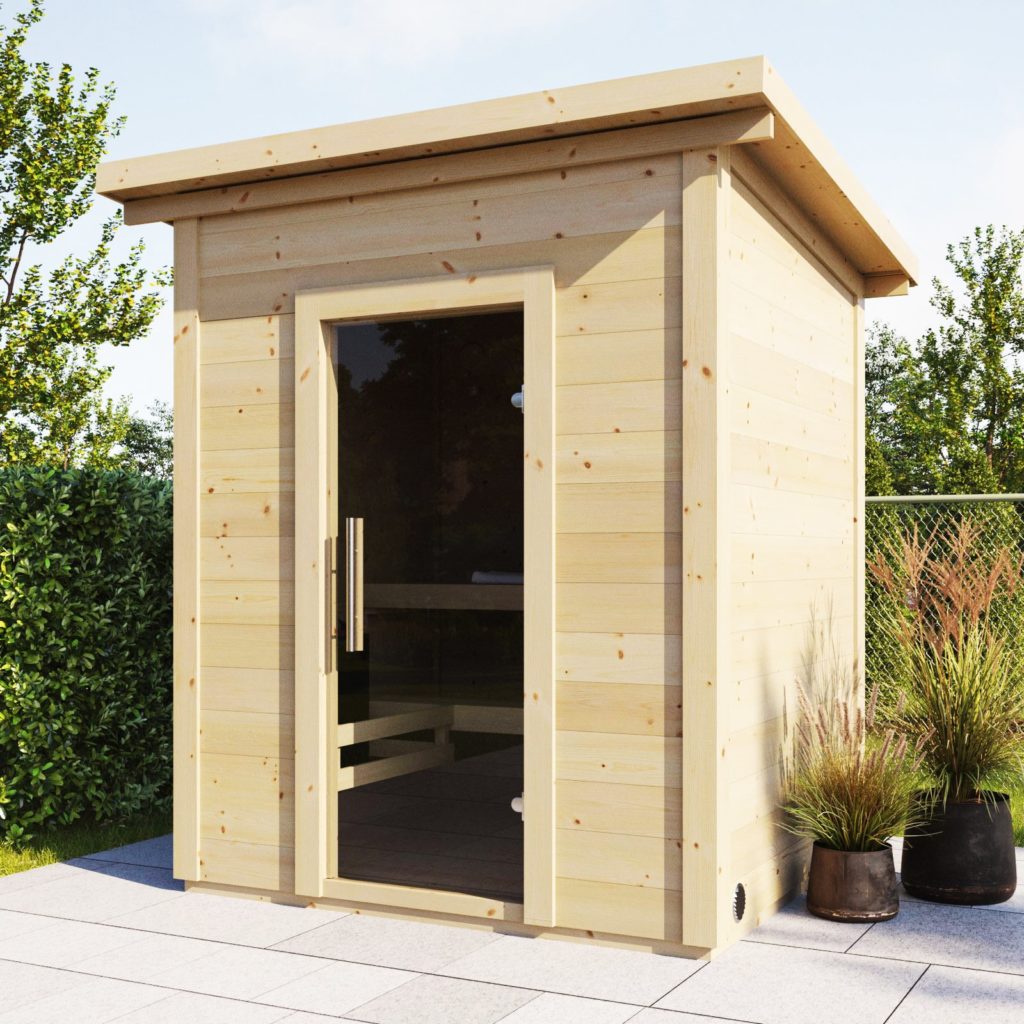
How do the SaunaBox Forge and SaunaLife Model G2 compare on published specs?
Direct answer
The Model G2 seats up to four people to the Forge's one, and it is the larger structure on the ground by roughly two and a half times. It is also a DIY kit: SaunaLife ships lumber, glass and hardware, and the buyer supplies two people and about two days of assembly labor, plus a separately purchased heater. The Forge ships as a fully specified cabin with its Harvia heater matched to the enclosure by SaunaBox, and it runs on a smaller 3.5 kW electrical load than any of the heaters SaunaLife recommends for the G2. The Forge is $4,990 (was $5,500) as a complete cabin, heater included. Everything else below is what each brand actually publishes.
| Specification | SaunaLife Model G2 | SaunaBox Forge 1-Person | Source / Basis |
|---|---|---|---|
| Sauna type | Traditional outdoor cabin sauna, DIY kit. Not infrared. | Traditional Finnish outdoor cabin sauna, pre-specified. Not infrared. | Product pages of both brands. |
| Price | Not published by SaunaLife directly. $4,990 for the sauna kit alone (no heater) at an authorized retailer. | $4,990 (was $5,500), heater and accessories included. | thesaunaheater.com, August 2026. saunabox.com, checked August 2026. |
| Capacity | Up to 4 people, two-tier benches. | 1 person. Single bench with an S-shaped ergonomic backrest. | Product pages of both brands. |
| Heater | Not included. Configurable for wood-fired stove or 6 kW electric. Recommended packages: Harvia Spirit SP60E, HUUM DROP 6kW or Harvia KIP80W, sold separately. | Harvia Vega Compact BU 3.5 kW, model #HCBU352401, factory-matched and included. Finnish commercial-grade. | saunalife.com and thesaunaheater.com. saunabox.com. |
| Electrical requirement | Not published. Depends entirely on which third-party heater the buyer selects; a 6 kW electric heater typically needs a dedicated 240V circuit sized to that unit. | 240V, 14.4A draw. Dedicated double-pole breaker, typically 20A. Hardwired, licensed electrician required. | saunalife.com. saunabox.com. |
| Maximum temperature | Not published on saunalife.com. | 220°F (104.4°C) maximum, published on the Forge product page. | saunalife.com, checked August 2026. saunabox.com. |
| Time to temperature | Not published. | 170°F in approximately 25 minutes from a cold start. 220°F in approximately 40 minutes from a cold start. | saunalife.com, checked August 2026. saunabox.com. |
| Exterior dimensions | 71.8″ W × 64.2″ D × 86.4″ H at the front roof peak (75.5″ H at the back). | 43.31″ W × 41.34″ D × 80.71″ H. | Product pages of both brands. |
| Ground footprint | Approximately 32.0 sq ft (calculated). | 12.4 sq ft (calculated). Roughly 39% of the G2's footprint. | Calculated from published exterior dimensions of both brands. |
| Interior dimensions | 67.3″ W × 60″ D × 75.5″ H. | 39.37″ W × 37.80″ D × 72.83″ H. Approximately 63 cu ft (calculated). | Product pages of both brands. Volume calculated for the Forge. |
| Interior wood | Hand-selected Aspen benches and backrest, 1.1″ thick, no-knots grade. | Canadian Hemlock, described as low-resin and low-odor, staying cool to the touch at full temperature. | Product pages of both brands. |
| Wall / exterior cladding | Premium Nordic Spruce wall beams, 1.65″ thick. | Cedar frame under matte black aluminum cladding. Wall thickness not published. | Product pages of both brands. |
| Roof | Self-adhesive EPDM roofing membrane. | Not published as a separate spec on the Forge page. | Product pages of both brands. |
| Door | Clear tempered glass, 5/16″ (8mm) thick. | Black-tinted tempered glass. Thickness not published. | Product pages of both brands. |
| Weight | 1,200 lb, shipped as flat-pack components. | 471.8 lb assembled. | Product pages of both brands. |
| Assembly | DIY kit. SaunaLife states "2 persons, 2-days" to build from flat-pack. | Ships pre-built as a consolidated unit. No structural assembly by the buyer. | saunalife.com. saunabox.com. |
| Electrical work required | Licensed electrician required for whichever heater is installed. Scope depends on heater chosen. | Licensed electrician required. 240V hardwired, no cord or plug included. | Product pages of both brands. |
| Warranty | "Limited lifetime warranty" on the sauna environment, per SaunaLife's own product page. | 2-year cabin warranty on frame, cladding, interior wood, door and hardware, plus a 1-year warranty on the Harvia heater. | Warranty sections of both brands. |
| Included accessories | Dimmable LED lighting, heater safety guard. Sauna stones and heater not included. | Sauna rocks, water bucket and ladle, wooden foot stool. | Product pages of both brands. |
What is the real difference between these two outdoor saunas?
Direct answer
It is not just size. It is how finished each product is when it arrives. The SaunaLife Model G2 is a kit: Nordic spruce wall panels, an EPDM roof, a glass door and hardware, shipped flat and built on site over roughly two days by two people, with a heater purchased separately and matched by the buyer. The SaunaBox Forge is a finished cabin with its heater already selected, sized and, per SaunaBox, installed at the factory. One is a construction project with a sauna at the end of it. The other is closer to an appliance delivery.
Be blunt about the capacity gap up front, because it is the single biggest fact in this comparison. SaunaLife's own page states the G2 fits up to four people across two bench tiers. The Forge has one bench. If you are buying for a household, or you want to sauna with a partner, this comparison is largely decided before you read another row: the G2 is built for that and the Forge is not.
What the capacity gap does not tell you is what it costs in labor and decisions. SaunaLife does not include a heater in the kit. The buyer has to pick one — a wood-fired stove, or an electric unit such as the HUUM DROP 6kW or a Harvia Spirit SP60E or KIP80W — buy it separately, and have it sized correctly for the cabin's volume by whoever installs it. The Forge skips that decision. SaunaBox has already matched a Harvia Vega Compact BU 3.5 kW heater to the Forge's roughly 63 cubic foot interior, and that heater ships as part of the unit.
The second cost of the kit format is time and labor, not just dollars. SaunaLife states two people and two days to assemble the G2 from flat-pack components. That is before the heater is chosen, sourced and wired. The Forge arrives as one consolidated cabin. There is no framing, no roofing membrane to lay and no panel-by-panel build sequence for the buyer to manage.
The single most consequential decision in any traditional sauna purchase is the heater. It sets the electrical load, it sets how long you wait for temperature, and it is the part most likely to need service over the life of the cabin.
SaunaLife does not sell the G2 with a heater attached to the price. The company states the enclosure "can be configured with a wood-fired sauna stove or a 6kW electric sauna heater," and its retail partners list separate heater packages ranging from roughly $2,147 to $3,279 at the time this article was checked. That means the buyer is doing the sizing work that a manufacturer would normally do: matching heater output in kW to interior cubic footage, confirming the recommended electrical circuit for that specific heater, and installing a second product from a second brand into the cabin.
The Forge removes that step. SaunaBox specifies a Harvia Vega Compact BU 3.5 kW heater, model #HCBU352401, sized to the Forge's interior and included with the unit. Harvia is a Finnish commercial heater manufacturer, and the model number is public, so a buyer can look up the exact heater they are getting rather than choosing among three third-party options after the sauna has already shipped.
Neither approach is wrong. A buyer who wants a wood-fired stove, or who wants to shop heater brands and prices independently, gets that flexibility from the G2's open configuration. A buyer who wants one box to arrive with the heating already solved gets that from the Forge. What is not equal is the amount of homework involved before either cabin can be turned on.
What kind of heat does each one make, and how does it feel?
Direct answer
Both are traditional saunas, so both heat the air and the sauna rocks rather than projecting infrared energy at the body. Neither the Forge nor the Model G2 uses infrared panels or red light therapy. On both, pouring water over the heated stones produces a burst of steam, called löyly in Finnish, but the core experience on both cabins is dry, high-temperature air.
This distinction matters because it is the most commonly confused point in the sauna category. A traditional sauna's rock stove heats the air in the cabin and the stones sitting on top of the heater. That hot air surrounds the bather and transfers heat to the skin by convection, and the stones radiate additional heat. That is a fundamentally different mechanism from an infrared cabin, where heating elements radiate energy that is absorbed more directly by tissue at a lower ambient air temperature. Traditional saunas like the Forge and the Model G2 run the room itself much hotter as a result — that is the entire point of the format.
Research on traditional Finnish-style sauna bathing has looked specifically at what that heat does physiologically. A 2018 review in Mayo Clinic Proceedings by Laukkanen and colleagues describes acute increases in heart rate and cardiac output during sauna sessions that resemble a moderate-intensity aerobic response, consistent with the body working to dissipate heat (PMID 29506732). A separate prospective cohort study by the same lead author, published in JAMA Internal Medicine in 2015, associated frequency of traditional sauna bathing with lower cardiovascular mortality in a Finnish population over roughly 20 years of follow-up (PMID 25705824). This is population-level association research, not a controlled trial of either of these two specific cabins, and it says nothing about outcomes for any individual user — but it is the reason traditional heat exposure of this kind is studied at all.
Separately, a 2021 review in Experimental Physiology by Périard and colleagues covers heat acclimation physiology more broadly, including how repeated passive heat exposure — of which traditional sauna bathing is one form — can produce adaptations such as increased plasma volume and improved thermoregulatory efficiency over repeated sessions (PMID 33527492). None of this is a claim that either the Forge or the Model G2 is superior at delivering these effects; both are rock-stove traditional saunas using the same underlying heat mechanism.
How hot does each sauna get, and how long does it take?
Direct answer
SaunaBox publishes a clear ceiling for the Forge: 220°F maximum, reached in approximately 40 minutes from a cold start, with 170°F reached in about 25 minutes. SaunaLife does not publish a maximum temperature or a heat-up time for the Model G2 anywhere on its product page.
This is a real, checkable gap and not a small one. Every published spec on the Forge's temperature curve comes with a number attached. The G2's temperature performance is left to the buyer's chosen heater and, by extension, whichever manufacturer made that heater. A HUUM or Harvia electric unit will publish its own output curve on its own product page, but that is a separate lookup the SaunaLife buyer has to do that the Forge buyer does not.
The practical consequence is time-to-use. A cabin that reaches 170°F in 25 minutes from cold, on a heater that is already matched to its volume, gives a predictable answer to "how long until I'm sitting in this." A kit with a heater chosen after the fact does not have one published answer — it has as many answers as there are heater options, and none of them are on SaunaLife's own page.
What are they built from?
Direct answer
The Model G2 uses 1.65-inch Nordic spruce wall beams with Aspen benches and backrests, an EPDM roof membrane and an 8mm tempered glass door. The Forge uses a Canadian Hemlock interior over a cedar frame, clad in matte black aluminum, with a black-tinted tempered glass door.
Spruce and Aspen are traditional Nordic sauna materials, and SaunaLife publishes real thickness figures for both the wall beams and the benches — 1.65 inches and 1.1 inches respectively, described as no-knots grade. That level of material detail is a genuine point in SaunaLife's favor; the Forge page does not publish a wall thickness for comparison.
SaunaBox's Canadian Hemlock is described as light-toned, low-resin and low-odor, and stated to stay cool to the touch at full temperature — a property that matters on bare skin during a 25-to-40-minute session. The Forge's black aluminum exterior is a visual and durability choice as much as anything: it reads as dark architecture on a patio rather than a natural wood structure in the garden, which is the look the G2's spruce and its EPDM roofline deliver instead. Neither exterior finish is objectively better. They are aimed at different aesthetics, and a buyer should pick based on what they want to see in the yard, not on which one this article prefers.
What electrical work does each one need?
Direct answer
Both require a licensed electrician and neither plugs into a standard wall outlet. The Forge's requirement is fully specified: 240V, 14.4A current draw, a dedicated double-pole breaker typically sized at 20A, hardwired, no cord or plug included. The Model G2's electrical requirement is not specified by SaunaLife at all, because it depends on which third-party heater the buyer chooses — a 6 kW electric unit, for example, will typically need a larger dedicated 240V circuit than the Forge's 3.5 kW heater draws.
This is the row where the Forge's fully specified approach pays off most clearly for planning purposes. A buyer can take the Forge's 14.4A, 240V figure straight to an electrician and get a real quote before ordering anything. A Model G2 buyer cannot do that from SaunaLife's own page — they first have to choose a heater from a separate retailer, find that heater's electrical spec on a different product page, and then get the electrician's quote.
That is not a criticism of the G2's heat output. A properly sized 6 kW heater in a four-person cabin is a reasonable, arguably faster-recovering setup for social use. It is a criticism of how much of the electrical planning is pushed onto the buyer before a single number is confirmed.
How does assembly and delivery compare?
Direct answer
The SaunaLife Model G2 ships as flat-pack components — wall panels, roofing, door hardware and trim — at approximately 1,200 lb, with SaunaLife stating a build time of "2 persons, 2-days." A heater still has to be sourced, delivered and installed separately before the sauna can be used. The SaunaBox Forge ships as a single consolidated cabin at 471.8 lb assembled, with the heater already fitted, so there is no structural build for the buyer to complete.
This is a genuine lifestyle trade-off, not a strict win for either brand. Some buyers want the DIY kit experience — a weekend project with a finished sauna at the end of it, more control over the build sequence, and the option to swap in a wood-fired stove instead of electric. SaunaLife is explicitly built for that buyer. Other buyers want the structural work already done and are only handling the electrical hookup. That is who the Forge is built for.
What buyers on either side should budget honestly for is the electrical connection. Neither a flat-pack kit nor a pre-built cabin changes the fact that a licensed electrician still has to run a dedicated 240V circuit before either sauna heats up. Assembly labor and electrical work are two separate line items, and the "2 persons, 2-days" figure from SaunaLife covers the structure, not the wiring.
How do the warranties compare?
Direct answer
SaunaLife states a "limited lifetime warranty" on the G2's sauna environment. The Forge carries a 2-year warranty on the cabin — frame, cladding, interior wood, door and hardware — plus a separate 1-year warranty on the Harvia Vega Compact heater.
On duration alone, this row goes to SaunaLife. A lifetime term is longer than two years by definition, and it is worth crediting them for publishing it plainly on their own product page rather than leaving warranty terms to a linked PDF a buyer has to hunt for.
The detail worth understanding is what each term actually covers. SaunaLife's own language specifies the "sauna environment," which on a DIY kit generally means the wood structure itself — not the heater, which is a separate purchase from a separate manufacturer with its own warranty terms that vary by which unit the buyer selects. The Forge's split warranty exists for a similar reason: SaunaBox warrants the cabin it builds for two years, while the Harvia heater is covered under Harvia's own one-year term because it is a third-party component, not something SaunaBox manufactures itself. In both cases, the heater's coverage is effectively separate from the wood structure's coverage — the G2 buyer just has to look it up on whichever heater brand they chose.
What does each purchase actually get you?
Direct answer
The Model G2 kit alone runs $4,990 at an authorized retailer, with no heater included — add roughly $2,147 to $3,279 more for one of SaunaLife's recommended heater packages before the sauna can be used, plus two people and about two days of build time. The Forge is $4,990 (was $5,500), and that price includes the heater, sauna rocks, a water bucket and ladle, and a wooden foot stool.
The two headline numbers happen to land in the same place, which makes the comparison unusually clean: $4,990 buys a complete, heated, pre-built one-person cabin from SaunaBox, or a four-person kit with no heater and no assembly done from SaunaLife. The G2 buyer is assembling two separate purchases — the kit and the heater — plus their own labor or a hired crew, before they have a working sauna.
Both brands leave real costs outside the headline number. SaunaLife's kit price does not include the heater or the electrician. The Forge's listing does not include the electrician either. Budget for a licensed 240V electrical hookup on either purchase, regardless of which cabin you choose.
What are the SaunaLife Model G2's genuine strengths?
Direct answer
The G2 seats up to four people against the Forge's one, carries a limited lifetime warranty against the Forge's 2-year cabin and 1-year heater terms, and lets the buyer choose between a wood-fired stove or an electric heater rather than a single fixed configuration. It also publishes more raw material detail — wall beam thickness, bench thickness and glass thickness — than the Forge page does.
A comparison that concedes nothing is an advertisement. Here is what the Model G2 does better, on published specs.
- Seats up to 4 people across two bench tiers. The Forge seats one. For couples, families or social sauna use, this is decisive.
- Limited lifetime warranty on the sauna environment, stated directly on SaunaLife's own product page.
- Heater choice: wood-fired stove or 6 kW electric, rather than one fixed factory configuration.
- Publishes wall beam thickness (1.65″), bench thickness (1.1″) and glass thickness (8mm). The Forge publishes none of these.
- Larger interior at 67.3″ W × 60″ D × 75.5″ H, built for multiple bathers at once rather than one.
- A traditional wood-and-EPDM cabin look that reads as a natural garden structure rather than a black architectural object.
What are the SaunaBox Forge's genuine strengths?
Direct answer
The Forge occupies roughly 12.4 sq ft against the G2's roughly 32.0 sq ft, ships as a finished cabin with its heater already matched and included, runs on a smaller 3.5 kW electrical load, and publishes a full published heat-up curve the G2 does not.
- 12.4 sq ft ground footprint against roughly 32.0 sq ft. It fits patios, decks, side returns and garages the G2 cannot enter.
- Ships with its Harvia Vega Compact BU 3.5 kW heater factory-matched and included. No separate heater purchase or sizing decision required.
- Named Finnish commercial heater with a public model number, #HCBU352401, and third-party parts availability through Harvia.
- Published 220°F maximum temperature, with 170°F reached in about 25 minutes and 220°F in about 40 minutes from a cold start. The G2 publishes neither figure.
- 240V, 14.4A draw on a typical 20A circuit — a smaller, fully specified electrical project than sizing a circuit for an unspecified third-party heater.
- Arrives as one consolidated, pre-built cabin rather than flat-pack components requiring roughly two days of assembly by two people.
- Canadian Hemlock interior, described as low-resin, low-odor and cool to the touch at full temperature.
Who should buy the SaunaBox Forge and who should buy the SaunaLife Model G2?
Direct answer
Buy the SaunaLife Model G2 if you want to sauna with multiple people, you want a DIY build project and heater flexibility, and you have the yard space for a roughly 32 sq ft structure. Buy the SaunaBox Forge if you sauna alone, your space is tight, and you want the heater decision already made for you. Headcount and how much building you want to do decide this, not spec sheets alone.
- You are the only regular user, or almost always sauna alone.
- Your space is tight. 12.4 sq ft fits where a 32 sq ft structure does not.
- You want the heater already matched to the cabin, not a separate purchase and sizing decision.
- You want a named third-party heater with a public model number.
- You do not want to spend a weekend, or two, building a flat-pack structure.
- You want the matte black architectural look rather than a natural spruce cabin.
- You want to sauna with a partner, family or friends. It seats up to four.
- You want the flexibility to choose a wood-fired stove or your own electric heater brand.
- You want a lifetime warranty on the sauna environment.
- You are comfortable with roughly two days of DIY assembly with a second person.
- You have the yard for a roughly 72 by 64 inch footprint and a straightforward electrical run.
- You want published wall, bench and glass thickness figures to evaluate build quality yourself.
Frequently asked questions
Neither is better across every category. The Forge wins on footprint, on having a heater already matched and included, on published heat-up time and maximum temperature, and on avoiding a DIY structural build. The Model G2 wins on capacity, warranty length and heater flexibility. The Forge is a one-person cabin for constrained spaces and buyers who don't want a build project. The G2 is a household DIY kit for buyers with the yard and the time to assemble it.
The Forge ships as a consolidated, pre-built cabin with its Harvia heater already matched and fitted. There is no structural assembly for the buyer to complete — the remaining work is the licensed electrical hookup. The SaunaLife Model G2, by contrast, is an explicit DIY kit; SaunaLife states "2 persons, 2-days" to build it from flat-pack wall panels, roofing and door hardware.
No. SaunaLife states the G2 "can be configured with a wood-fired sauna stove or a 6kW electric sauna heater," and its authorized retailers sell separate heater packages — Harvia Spirit SP60E, HUUM DROP 6kW and Harvia KIP80W were the options listed at the time this article was checked, running roughly $2,147 to $3,279 in addition to the kit. The SaunaBox Forge includes its Harvia Vega Compact BU 3.5 kW heater as part of the unit.
SaunaBox publishes a 220°F maximum for the Forge, reaching 170°F in approximately 25 minutes and 220°F in approximately 40 minutes from a cold start. SaunaLife does not publish a maximum temperature or a heat-up time for the Model G2 on its product page — that figure would depend on whichever third-party heater the buyer eventually installs.
The SaunaBox Forge needs a dedicated 240V double-pole breaker, typically 20 amps, with a current draw of 14.4A. The SaunaLife Model G2 has no published electrical requirement, because it depends on the heater the buyer selects; a 6 kW electric heater will typically require a larger dedicated 240V circuit than the Forge's 3.5 kW unit. Both saunas require a licensed electrician, and neither plugs into a standard wall outlet.
No. Both the SaunaBox Forge and the SaunaLife Model G2 are traditional saunas that heat the air and the stones with a rock stove. Neither includes infrared panels or red light therapy. If you are looking for an infrared cabin, that is a different product category and neither of these is it.
The SaunaLife Model G2 is published as fitting up to 4 people across two bench tiers. The SaunaBox Forge seats 1, with a single bench and an S-shaped ergonomic backrest. If you need to seat more than one person at a time, the Model G2 is the correct choice of these two.
The SaunaLife Model G2 uses 1.65-inch Nordic spruce wall beams with hand-selected Aspen benches and backrests. The SaunaBox Forge uses a Canadian Hemlock interior, described as low-resin and low-odor, over a cedar frame clad in matte black aluminum panels.
The SaunaLife Model G2 ships as flat-pack components at approximately 1,200 lb, with SaunaLife stating a build time of two people over two days, not including heater installation. The SaunaBox Forge ships as a single pre-built cabin at 471.8 lb assembled, with the heater already fitted, so the buyer's remaining work is the electrical hookup. Both still require a licensed electrician for the 240V connection.
SaunaLife states a "limited lifetime warranty" on the Model G2's sauna environment. The SaunaBox Forge carries a 2-year warranty on the cabin structure, cladding, interior wood, door and hardware, plus a separate 1-year warranty on the Harvia Vega Compact heater. On duration, the lifetime term is the longer of the two.
The SaunaLife Model G2 kit runs $4,990 at an authorized retailer, not including a heater, which adds roughly $2,147 to $3,279 depending on the package chosen. The SaunaBox Forge is $4,990 (was $5,500) and includes the heater; the G2 kit does not.
The SaunaBox Forge. Its exterior is 43.31 inches wide by 41.34 inches deep, a ground footprint of about 12.4 square feet. The SaunaLife Model G2 is 71.8 inches wide by 64.2 inches deep, a footprint of roughly 32.0 square feet. The G2 needs close to two and a half times the ground area of the Forge.
The bottom line
SaunaBox Forge vs SaunaLife Model G2The SaunaLife Model G2 is the better buy for a household that wants to sauna together, is comfortable with a two-day DIY build, and wants the flexibility to choose its own heater and pick between wood-fired or electric. It carries a lifetime warranty on the structure and publishes real material thickness figures. If you have the yard, the time and the appetite for a build project, that is a genuinely strong package.
The SaunaBox Forge answers a different question. It is for the person who saunas alone, does not have 32 square feet of yard to give up, and does not want to shop for and size a separate heater before their sauna can be used. It ships pre-built with a named Finnish Harvia heater already matched to the cabin, and it publishes a full heat-up curve to 220°F.
Choose the Model G2 if the constraint is headcount and you want to build it yourself. Choose the Forge if the constraint is space and you want the heater decision already made. The Forge is $4,990; check saunabox.com to confirm current pricing before you buy.
See the SaunaBox ForgeSources and references
- SaunaBox Forge 1-Person Traditional Finnish Sauna, product page and specification block — saunabox.com. Checked August 2026.
- SaunaLife Garden-Series Model G2, product page — saunalife.com. Checked August 2026.
- SaunaLife Model G2 kit and heater package pricing — thesaunaheater.com, an authorized SaunaLife retailer. Checked August 2026.
- Laukkanen T, Khan H, Zaccardi F, Laukkanen JA. Association Between Sauna Bathing and Fatal Cardiovascular and All-Cause Mortality Events. JAMA Internal Medicine, 2015. PMID 25705824.
- Laukkanen JA, Laukkanen T, Kunutsor SK. Cardiovascular and Other Health Benefits of Sauna Bathing. Mayo Clinic Proceedings, 2018. PMID 29506732.
- Périard JD, Eijsvogels TMH, Daanen HAM. Heat Stress: Physiology, Adaptation, and Performance. Experimental Physiology, 2021. PMID 33527492.
HAVE QUESTIONS?
Text a SaunaBox product specialist.
No bots. Real answers in under an hour.
Disclaimer: This content is for informational and comparison purposes only and should not be construed as medical advice. All specifications reflect what each brand publishes on its own website, or an authorized retailer's website, as of August 2026. Figures marked "calculated" are our arithmetic on published dimensions, not manufacturer specifications. Prices reflect list pricing at the time of writing and are subject to change; confirm current pricing at saunabox.com. Verify current specifications, pricing, certification and warranty terms directly with each brand before purchasing. Both saunas require a hardwired 240V connection installed by a licensed electrician. If you have any underlying health conditions, consult a qualified healthcare clinician before beginning sauna therapy.


